
Weekend Subjunctive Practice 23: Tener miedo de que / Dar miedo que
¡Bienvenido a nuestro hilo! Each weekend, Cordobesa and I will present a different topic on everybody’s favorite subject… the subjunctive!
We will give an explanation of the topic, and a couple of examples.
Write sentences at least 5 words long. Write your Spanish sentence, and include the English translation as well. Make the corrections suggested by Cordobesa in the comments section. Use your own words! (Don't use a translator, copy from a book, use song lyrics, etc.)
Post pictures if you’d like, and don’t forget to vote on the sentences you like best. The winner will be chosen based upon the correct use of the topic as well as the number of votes.
¡Vamos allá!
Weekend Subjunctive Practice 23: Tener miedo de que
Explanation:
Just like “Tener ganas de”, from Weekend Subjunctive Practice 15, “Tener miedo de/a” is a very common expression. It means “to have a fear of” or “to be afraid of” something.
Tengo miedo de/a las arañas. I have a fear of spiders. I’m afraid of spiders.
¿Tienes miedo de/a la oscuridad? Do you have a fear of the dark? Are you afraid of the dark?
However, as we have seen many times, when there is a change of subject, “que” is used, and the verb following “que” is conjugated in the subjunctive.
Examples:
Tenía miedo de que mi novia tuviera que irse más temprano de lo normal.
I was afraid that my girlfriend had to leave earlier than normal.
Me da mucho miedo que el avión se estrelle.
I’m very scared that the plane will crash.
¡Os toca a vosotros!
Click here for last weekend’s subjunctive practice: En cuanto
11 Answers
Quiero hacer este hilo de nuevo, porque tengo ganas de aprenderlo más ,
pero tengo miedo de fallar .
I want to do this thread again because I have a desire to learn it,
but I have a fear of failure.
I'm afraid all the rain we're having will cause a mudslide.
Tengo miedo de que toda la lluvia que estamos teniendo provoque una avalancha de lodo.
(Please correct my Spanish.)

Tenía mucho miedo que no habría ninguna torta restante cuando que llegué a casa.
Tenía mucho miedo de que no hubiera ninguna torta restante cuando llegara a casa.
I was very afraid there would be no cake left by the time I got home.

No tenía miedo de que su amigo pudiera hacerse daño.
No le daba miedo que su amigo pudiera hacerse daño.
He was not afraid that his friend could get hurt.

Me pregunto si es el temor de tener miedo lo que me asusta más que nada.
I wonder if it's the fear of fear that scares me more than anything.

Tengo miedo de que mañana tengamos que buscar a un médico que quiera hacer una radiografía del tobillo de mi marido.
I'm worried that tomorrow we might have to look for a doctor that is willing to x-ray my husband's ankle.

Cenicienta tiene miedo de que deba salir del castillo a medianoche porque si no se marche se vuelva a ser de nuevo a la muchacha desharrapada como de costumbre.
Cinderella is afraid that she should exit the Castle at midnight because if not, she turns again to be the ragged girl as usual
They are afraid that the engagement photos will not turn out.
Les da
danmiedo que las fotos de compromiso no salgan bien.

The children were afraid that the last in line wouldn't get his treats.
Los niños tenían miedo de que el ultimo en la cola no consiguiera
consigasus dulces.
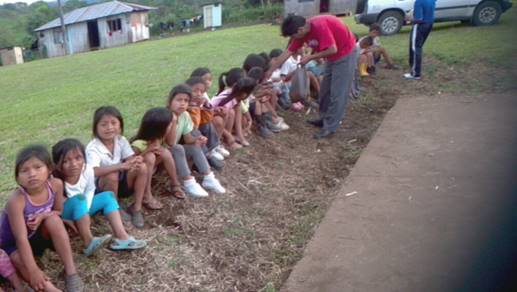
Les da miedo de que el pequeño barco se hunda en el mar, pero les da más miedo de que la guerra en su país destruya sus vidas.
They are afraid that the small boat will sink in the sea, but they are more afraid that the war in their country will destroy their lives.

Tenía miedo de que se quemara las tartas durante el concurso de cocina la semana que viene ¡y sin querer, que se prendiera fuego a los estudios de T.V!
She was afraid that she would burn the cakes in the cooking competition next week and accidentally set the T.V. studio alight!
alight ie: on fire!
accidentally or unintentionally
Corrijan mi español si es necesario, por favor 
Me da miedo que todavía no me haya llamado la enfermera para decirme que la operación de mi marido ha salido bien. O peor, para decirme que aún no ha tenido la operación.O, aún peor, lo hayan operado pero no ha salido bien.
I'm very woried because the nurse has still not rung me to say that my husband's operation has gone well. Or indeed, that he has not yet been operated on. Or , even worse, that he has had the operation but it has not gone well.
















