
Negative imperatives in Spanish trigger the subjunctive,Explanation wanted .
I was asked to correct a sentence because I used "busca" instead of "busques "
my sentence was in the negative which I was told triggered the "subjunctive".
Although this sounded correct and familiar to me I would like to have a refresher
from one of our clever and knowledgable members , please keep it simple.


6 Answers
You just need to revise the imperative. I learnt the imperative as a build up to the subjunctive as most forms use the subjunctive mood. Tu is different as it only uses the subjunctive mood on negative commands.
This sets it out well but as it is based in USA doesn't explain vosotros, but you probably remember that one! Buscad is the affirmative but like tu, in a negative command it uses the subjunctive form.
I was asked to post an answer to this question, not because anybody was incorrect in their information, but they appreciate the simple way I state difficult truths.
Imperatives: These are phrases where you are telling someone to do something.
There are three kinds. Informal (tú, vosotros) formal (usted, ustedes) and "Nosotros" comanda. "Lets eat at "El Cholo's)
The easiest ones are the formal commands. Just use the subjunctive forms of the verb. Remember that irregular verbs have their own peculiarities beside the endings. I will just give the regular verbs here.
"Camine Ud)." "Caminen )Uds)." Walk
Coma (Ud.) Coman (Uds). Eat
Escriba (Ud) Escriban (Uds). Write
The tricky ones are the familiar commands.
The positive commands for "tú" are the same as the third person (and usted) form. Using the same verbs.
Camina, Come, Escribe.
For the negative command, use the subjunctive of the "tú" form. No camines, No comas, No escribas.
For vosotros commands, just remove the "r" from the infinitive and replace with "d."
Caminad, Comed, Escribid. For the negative commands use the subjunctive.
No caminéis, No comáis, No escribáis.
For the Nosotros command just use the subjunctive for both directions.
Caminemos--No caminemos, Comamos---No comamos, Escribamos,---No escribamos.
Now the above is for regular verbs only.
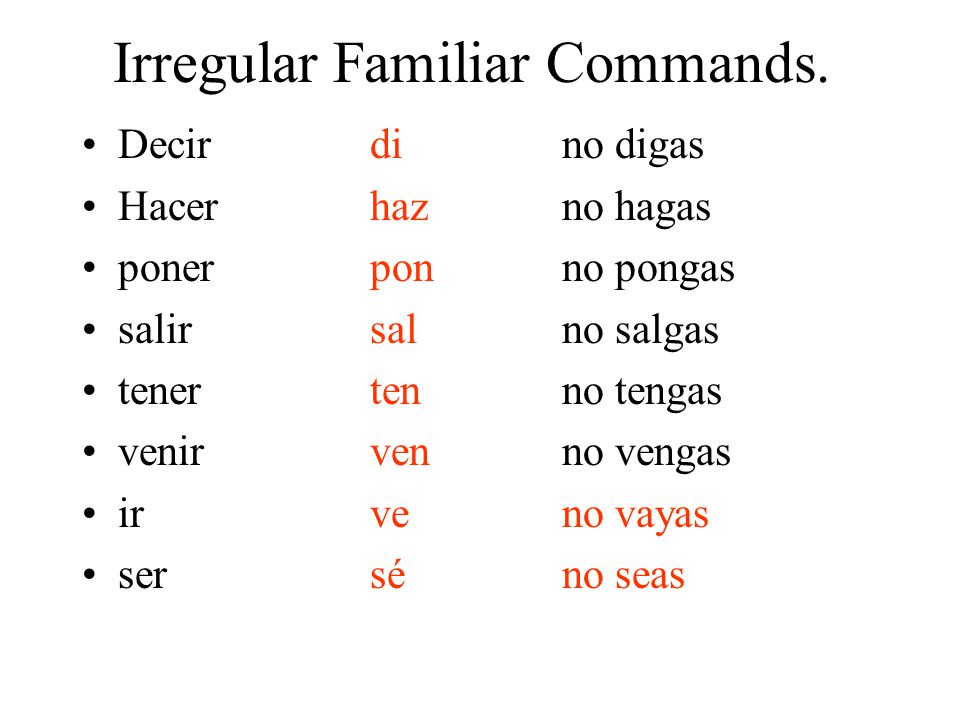
Some of the irregular verbs have totally different positive command forms.
Ser--sé, No seas, Tener--ten, No tengas, Venir--ven, No vengas, Hacer --Haz,-No hagas, and a bunch more that can be found in the grammar section on SD
There are also other matters, like where to put pronouns. Attatch them to the positive command and place them before the negative command.
Tráemelo--No me lo traigas. (Have you noticed that in this section I have used only irregular verbs?)
There are several ways to get this, study a well structured class where you get only a little bit at a time or go crazy with a mountain of information all hitting you in the face at the same time. I still think that Parelee's course is great. You just get a little bit at a time. Just enough to swallow.
Negative tú commands are very different- you put no in front of the tú subjunctive form, and pronouns precede. It is essentially the same as expressing an implicit wish in form. You will not find these forms listed in the conjugation under imperatives, you need to remember to use the subjunctive form. Still it is better to think of it as the negative command form is the same as the subjunctive, rather than that the no "triggers" the subjunctive.
The problem with this message is that it gives the impression that Tú imperative negative expresses a wish while the other persons do not - this is wrong. All persons in the imperative positive and negative express the same level of feeling (nuance). The conjugation of Tú imperative negative just happens to be the same conjugation as that of Tú present subjunctive but with imperative we don´t wish - we demand.
Formal commands also use the subjunctive (for that form)- but in this case both in the positive and the negative, singular and plural.
The same with this message. A wish is not a demand, the conjugations just happen to be the same but the nuance between subjunctive and imperative is very different.
When you learn the language as a native you naturally learn all the nuances during childhood, but you don´t notice these similarities of conjugation until later when you study grammar, so it´s best not to think of "imperative uses subjunctive".
Commands at the simplest:
There are 8 irregular positive tú commands which must be learned, outside these 8, the form is identical to the 3rd person present indicative, however pronouns if present are attached to the end, and an accent is placed if necessary to maintain the correct stress. When it would be difficult to tell a command from a third person conjugation, exclamation points can be used to make it clear it is the command.
¡Nada! --- Swim!, not he swims.
¡Cómpralo! --- Buy it!
¡Hazlo! --- Do it!
http://www.spanishdict.com/topics/show/65
Negative tú commands are very different- you put no in front of the tú subjunctive form, and pronouns precede. It is essentially the same as expressing an implicit wish in form. You will not find these forms listed in the conjugation under imperatives, you need to remember to use the subjunctive form. Still it is better to think of it as the negative command form is the same as the subjunctive, rather than that the no "triggers" the subjunctive.
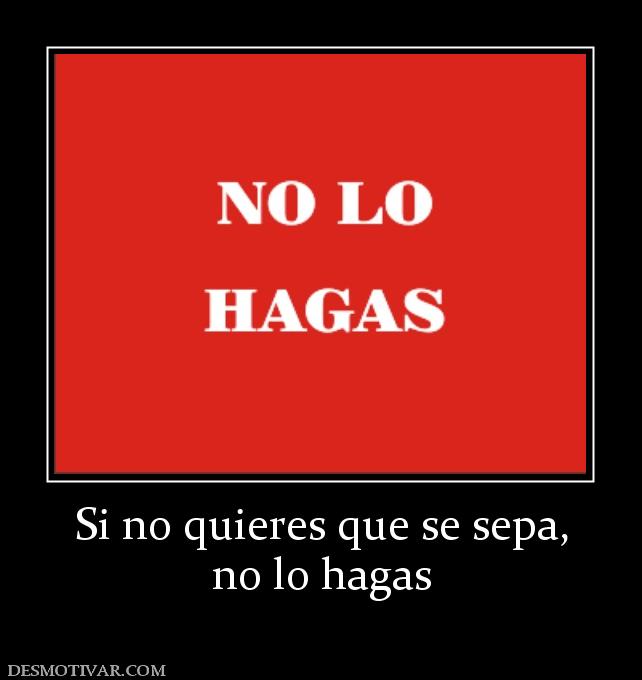
Quiero que no lo hagas. I want that you don't do it (I don't want you to do it).
¡No lo hagas! Don't do it!
http://www.spanishdict.com/topics/show/66
Formal commands also use the subjunctive (for that form)- but in this case both in the positive and the negative, singular and plural. In the positive forms the pronouns are attached, like the positive informal command, and thus do not follow the form of an indirect wish. In the negatives the pronouns proceed, just like the informal case.
¡Hágalo! Do it! (formal, usted)
¡No lo haga! Don't do it! (formal, usted)
http://www.spanishdict.com/topics/show/67
For those learning English it is much simpler.
Just use the base verb (infinitive without the "to") in all cases for all verbs.
Do it! - Don't do it!
Just thought I'd point that out. 
So is that ,Do it! - Don't do it!
¡Así es que, ¡Hazlo! - No lo hagas . Tu no puede lo hagas !
So is it, Do it! - Do not do it . You can not do it!
Is that correct ?
¿Es eso correcto?

















