
another question about meaning of 'le'
Apologies in advance if the content in this question is offensive to you! ...
Que le enseñes a mi boca tus lugares favoritos.
That you teach, to my mouth your favorite places.
I recently asked a similar (I think) question about 'le' ... see here
Is this another example of 'le' meaning 'for you', or 'to benefit him or her', or 'for it' (the mouth) ...?
I am holding some doubt because this time it is subjunctive... It reminds me of "Que le vaya bien".. Which means roughly "That for you, it goes well."
But here if 'le' were translated as for the other persons benefit, shouldn't it be 'te' and not 'le' ?
So I am thinking that the 'le' is referring to the mouth.
Again, let me know if I'm wrong, and sorry for the content if that is a problem, feel free to delete.
Thanks for everyone who answers my questions!
3 Answers
This use of "qué" in this manner plus the subjunctive may be translated as:
"May you teach my mouth your favorite places"
The longer version could be "Ojalá que---- Espero que-----quisiera que, etc.
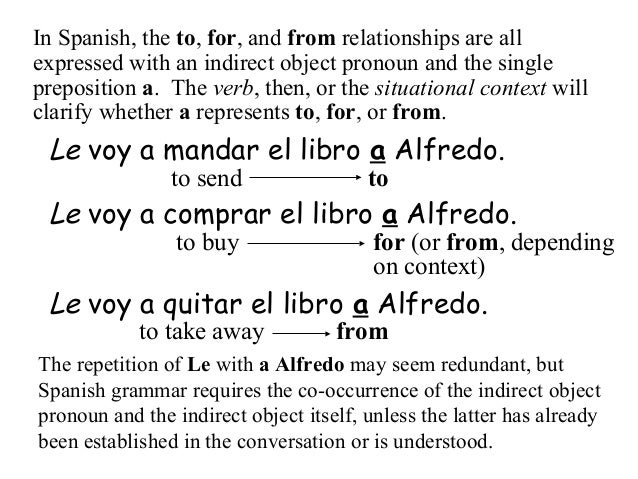
And the "le" is what English speakers call the "redundant" le. It makes no sense in English but you see it all the time in Spanish. Some constructions require it.
Here's a chart illustrating the "redundant" le.
So you could say "Que le enseñes tus lugares favoritos" only if "A mi boca" is understood previously from the conversation? - Joe1242
Ok, let's use our imagination:
Oye...te hablo de mi boca.
sí, ¿y qué?
¡que le enseñes tus lugares favoritos!
ah, claro, vale, así haré
Hence: yes, you can. 
Que le enseñes a mi boca tus lugares favoritos.
That you teach your favorite places to my mouth.
It's possible to say.
Que enseñes a mi boca tus lugares favoritos but most people repeat and "le" means a mi boca. So it's redundant. "A mi boca" is like said twice.
This happens a lot in Spanish.
A mi me gustan las manzanas. It would be enough to say "Me gustan las manzanas" but we normally add " A mí".
This one is similar to "Que le vaya bien".


