
Sephardic Jews
Are Sephardic Jews with ancestry linked to Spain considered Hispanic? Apparently there is controversy in this question.
Thank you!
5 Answers
Jews comprise a lot of ethnicities. There are German Jews, Polish Jews, Ethiopian Jews, and many others. Up until 1492 They were fairly prosperous in Spain, and Spain prospered, but when the high mucky-mucks of the Catholic Church got a little concerned about this, they started the Inquisition and many Jews were burned at the stake. Some escaped to South America, some to other places.
My mother is from Canada--a French speaking Canadian, My father is a Spaniard from a long line of sefardíes. I also was born in Spain. I am Hispanic. A Hispanic is someone whose native language is Spanish. They don't even have to be born in a Spanish speaking country. There are millions of Hispanics in the US who were born here.
Hispanics come in all sorts of colors and body types. From the extremely light blond hair types you see in central and Northern Spain, to the darkest African type. In fact the majority race in Cuba is Black. There are some White, and a lot of Black White blends. All are Hispanics.
Mexicans are similar. There are light-skinned, dark-skinned, red hair, black hair, blond, brown, etc. All are Hispanics. Among them looking just like other Mexicans, speaking the same dialect of Spanish are all kinds of Jews, including the rather recent group, who also follow Jesus Christ. They are called Messianic Jews.
The present Pope of the Catholic Church whom is greatly admired, is Hispanic--his first language is Spanish, and he comes from Argentina. However, he has an Italian name which I have forgotten-- something like Bertolinni or close to it.
I know something about sefarditas--I am one, who also identifies with the Messianic Jewish movement. The Conservative and Orthodox Sephardic Jews have their own language called "Ladino" which is very much like Spanish, enough for me to understand, but I didn't remain in Spain long enough to learn it.
It is interesting that before Hebrew was officially proclaimed as the language of Israel, the people there either spoke Yiddish, or Ladino, or English.
It's also interesting that there are two dialects (varieties of pronunciation) Found in the Hebrew. One is called Ashkinazic, and the other Sephardic. The Sephardic is now the preferred dialect in Israel today.
I hope some other Jewish person will contribute to this discussion. There is an old saying that when you get two Jews in a discussion, you'll get at least three different opinions. 
History of Jews in Spain.
It is said that the first Jews arrived in Seville in the sixth century BC, and were from David's family. They spoke Ladino, a Judeo form of Spanish. The Sephardic Jews suffered persecution from the Visigoths during the sixth century AD, followed by a period of harmony under Moorish rule, during which Jews, Moors and Christians co-existed, respecting each other's religions and holy days, each with their own skills to offer; they were employed as court envoys. In the 13th century they fled the fundamentalist Almohads to the Christian north of Spain, returning after the Reconquest. Sephardim prospered in banking, medicine, law and commerce, with a far higher literacy rate than other Spanish communities
It is said that the first Jews arrived in Seville in the sixth century BC, and were from David's family. They spoke Ladino, a Judeo form of Spanish. The Sephardic Jews suffered persecution from the Visigoths during the sixth century AD, followed by a period of harmony under Moorish rule, during which Jews, Moors and Christians co-existed, respecting each other's religions and holy days, each with their own skills to offer; they were employed as court envoys. In the 13th century they fled the fundamentalist Almohads to the Christian north of Spain, returning after the Reconquest. Sephardim prospered in banking, medicine, law and commerce, with a far higher literacy rate than other Spanish communities

Spanish Jews once constituted one of the largest and most prosperous Jewish communities in the world. This period ended definitively with the anti-Jewish riots of 1392 and Alhambra decree of 1492, as a result of which the majority of Jews in Spain (between 200,000 and 250,000) converted to Catholicism and those remaining (between 40,000 and 100,000) were forced into exile.
An estimated 13,000 to 50,000 Jews live in Spain today, concentrated in the provinces of Malaga, Madrid and Barcelona as well as having a historic presence in the autonomous cities of Ceuta and Melilla. A significant portion of these are Spanish-speaking Jews who returned to Spain after centuries of exile in northern Morocco during and after the Spanish protectorate. Ashkenazi Jews, primarily from Latin America but also of European origin are also present in Spain.
Who are the Sephardic Jews?
In the narrower ethnic definition, a Sephardi Jew is a Jew descended from the Jews who lived in the Iberian Peninsula in the late 15th century, immediately prior to the issuance of the Alhambra Decree of 1492 by order of the Catholic Monarchs in Spain, and the decree of 1496 in Portugal by order of King Manuel I.
In the narrower ethnic definition, a Sephardi Jew is a Jew descended from the Jews who lived in the Iberian Peninsula in the late 15th century, immediately prior to the issuance of the Alhambra Decree of 1492 by order of the Catholic Monarchs in Spain, and the decree of 1496 in Portugal by order of King Manuel I.

Judaeo-Spanish
Judaeo-Spanish (also Judeo-Spanish and Judæo-Spanish: Judeo-Español, Hebrew script: ???????-??????????, with many variant spellings in all scripts, as in the box at right), commonly referred to as Ladino, is a Romance language derived from Old Spanish. Originally spoken in the former territories of the Ottoman Empire (the Balkans, Turkey, the Middle East, and North Africa) as well as in France, Italy, the Netherlands, Morocco, and the United Kingdom, today it is spoken mainly by Sephardic minorities in more than 30 countries, most of the speakers residing in Israel. Although it has no official status in any country, it has been acknowledged as a minority language in Bosnia and Herzegovina, Israel, France and Turkey.
The core vocabulary of Judaeo-Spanish is Old Spanish and it has numerous elements from all the old Romance languages of the Iberian Peninsula: Old Aragonese, Astur-Leonese, Old Catalan, Galician-Portuguese and Mozarabic.[3] The language has been further enriched by Ottoman Turkish and Semitic vocabulary, such as Hebrew, Aramaic, and Arabic, especially in the domains of religion, law and spirituality and most of the vocabulary for new and modern concepts has been adopted through French and Italian. Furthermore, the language is influenced to a lesser degree by other local languages of the Balkans, such as Greek, Bulgarian and Serbo-Croatian.
Historically, the* Rashi* script and its cursive form Solitreo have been the main orthographies for writing Judaeo-Spanish. However today, it is mainly written with the Latin alphabet, though some other alphabets such as Hebrew and Cyrillic are still in use. Judaeo-Spanish is known by many different names, mostly: Español/Espanyol, Judió/Djudyo (or Jidió/Djidyo), Judesmo/Djudezmo, Sefaradhí/Sefaradi and ?aketilla/Haketia. In Turkey and formerly in the Ottoman Empire, it has been traditionally called Yahudice in Turkish, meaning the Jewish language. In Israel, Hebrew speakers usually call the language (E)spanyolit or Ladino.
Judaeo-Spanish once the trade language of the Adriatic Sea, the Balkans and the Middle-East and renowned for its rich literature especially in Salonika, today is under serious threat of extinction. Most native speakers are elderly and the language is not transmitted to their children or grandchildren for various reasons. In some expatriate communities in Latin America and elsewhere, there is a threat of dialect levelling resulting in extinction by assimilation into modern Spanish. It is experiencing, however, a minor revival among Sephardic communities, especially in music.
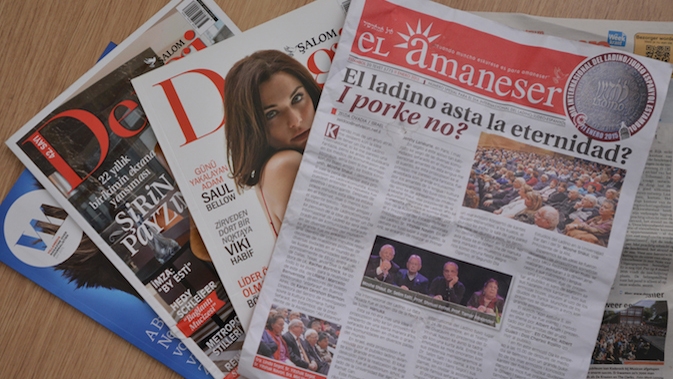
Hubo comunidades judías establecidas en la península ibérica por más de mil años. Sus miembros se llamaron sefardíes, porque ellos llaman Sefarad a esa tierra, en contraposicion con las comunidades asquenazíes, que son los judíos provenientes del norte de Europa.
En 1492, los reyes católicos, soberanos de Castilla, después de conquistar Granada, los expulsaron del país. Fue una verdadera tragedia para ellos porque esa era su casa. Y fue un desastre para Castilla, porque dejó ir a la que probablemente era la comunidad más activa económicamente, la más exitosa académicamente, la más dotada en el sentido comercial, entre otras virtudes. Quizás podemos encontrar un paralelo en Francia cuando los hugonotes fueron expulsados.
Ellos migraron principalmente al territorio del antiguo imperio otomano, que entonces incluía porciones de Africa, Asia y Europa oriental, y a los Países Bajos (Holanda). En ambos sitios fueron acogidos, y se asentaron, pero la nostalgia hasta hoy va con ellos. Alguien los llamó "los judíos que lloran a España". Esa es una hermosísima manera de describirlos.
Estas personas hablan español, con algunos detalles arcaizantes, pero completamente entendible. A esta modalidad del español le llaman ladino. No es ni siquiera un dialecto, es el mismo idioma. En ocasiones suena como español con acento gallego (me refiero al idioma de Galicia).
El último Sefardí - Documental
Ejemplo de ladino hablado hoy:
- Minuto 7:48, señora mayor.
En el siglo XX en España ha existido la tendencia política a considerar a los sefardíes como españoles de pleno derecho, por lo que se les otorgaba la nacionalidad por Real Decreto a quien la solicitase. Hoy ya existe una ley para otorgarles la nacionalidad a quien la solicite, siempre que pueda probar que es sefardí. Desde el 2008 hasta el 2015 unos 740 sefardíes se han convertido legalmente en españoles.


