
Do irregular verbs have different endings for Preterite, future, and conditional tenses?
I'm in the process of learning how to use past, present, and future tenses. I understand how the endings of words change for past, future, and conditional tenses....Do irregular verb endings change with these tenses?
2 Answers
The endings for each tense remain the same except for some verbs in the preterite.
The irregularities usually occur in the stem, the endings are not different from the regular verbs.
Here's the list of the verbs which have very different endings in the preterite. Notice that some are "ar" verbs, some are "er", and some "ir" yet they all have the same irregular endings. And just look at what happens to the stem.
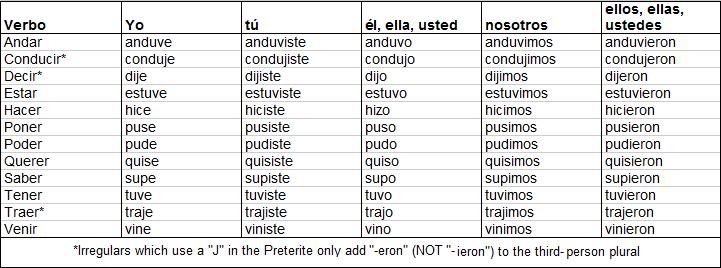
The future and conditional tense endings remain constant, but the stems undergo a change. Here's a chart showing how the stems are changed. To these stems you merely add the future or conditional endings. These aren't all of them but they are the most used ones.

Irregular verbs are verbs that are irregular in some forms of some tenses, but that does not mean they will be irregular in all tenses. And they can be irregular in similar patterns, or very different patterns. Each tense has its own endings.
For instance most say there are only three irregulars in the imperfect tense. Ser, ir and ver. In essence ser is completely irregular, dar takes the “wrong”endings, and ver simply retains an e. So an irregular verb like tener, irregular in many tenses, is perfectly regular in the imperfect.
I think there are 12 in the future tenses. They are irregular in what happens in the stem, and not the ending. The stem changes are the same for the condition, and the endings are the usual conditional endings. See here for the future:
http://www.spanishdict.com/guide/irregular-simple-future-forms
When you read things like that, you have to remember that verbs that are based on an irregular are going to conjugated just the same way, and are not counted in those lists.
Prever like ver, mantener like tener, suponder like poner, etc.
If you have a more specific question that might get you more focused information.

















