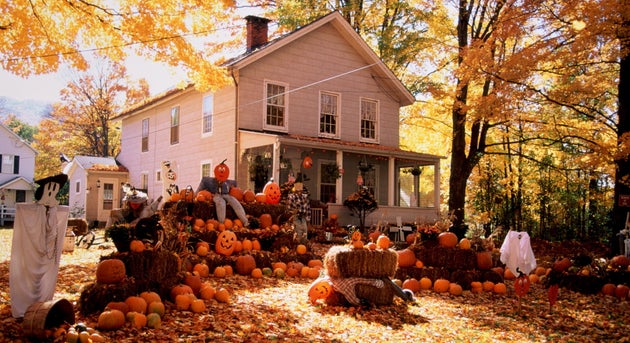
"Halloween" Spanish words to use for Halloween:Happy trick or treating!
Thinking about Halloween.
I remembered things such as pumpkin
pie, pumpkin doughnuts, pumpkin cheesecake,
pumpkin ice cream, pumpkin latte, and my
favorite: pumpkin pancakes. Thinking about
so many pumpkin-things really put me in a
mood so I thought that we could all contribute our own special things .
I remembered things such as pumpkin pie, pumpkin doughnuts, pumpkin cheesecake, pumpkin ice cream, pumpkin latte, and my favorite: pumpkin pancakes. Thinking about so many pumpkin-things really put me in a mood so I thought that we could all contribute our own special things .
1. disfrazar - to dress up, to disguise
2. calabaza - pumpkin
Me regalaron una calabaza decorativa.
They gave me a decorative pumpkin.
3. disfraz - costume
Mi esposa compró un disfraz de bruja para usarlo en la fiesta de Halloween.
(My wife bought a witch's costume in order to wear at the Halloween party.)
4. asustar - to scare
El gato negro me asustó.
The black cat scared me.
5. casa embrujada - haunted house.
La casa embrujada tiene arañas, esqueletos y murciélagos.
(The haunted house has spiders, skeletons and bats.)
List all the things that you do
and all the things that you have.
In both languages please.
15 Answers
Estamos teniendo una "fiesta de Halloween.
We're having a "Halloween party.

Day of The Dead Australia
Day of The Dead Australia honours the longstanding traditions of Mexico’s Dia de los Muertos by celebrating it with a creative spectacle set in various cities around the country. Guests become a part of the experiential project by dressing up in costume and becoming immersed in a world of debauchery. Curated by a group of Mexican visionaries and artists, Day of The Dead creates a spectacle complete with interactive art installations, light projections, street art and live music.
Day of The Dead Australia honours the longstanding traditions of Mexico’s Dia de los Muertos by celebrating it with a creative spectacle set in various cities around the country. Guests become a part of the experiential project by dressing up in costume and becoming immersed in a world of debauchery. Curated by a group of Mexican visionaries and artists, Day of The Dead creates a spectacle complete with interactive art installations, light projections, street art and live music.
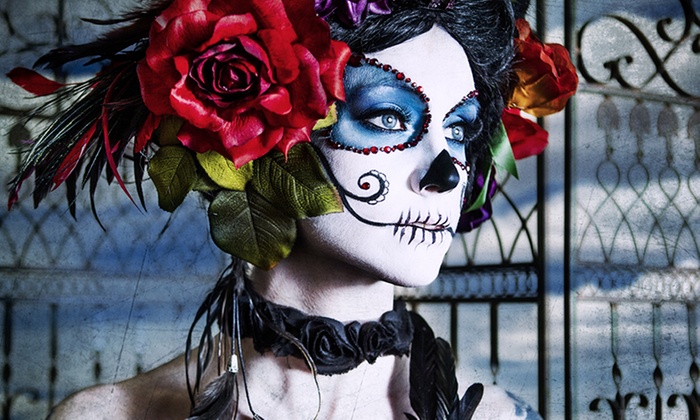
Grupo de música para Halloween.
Music group for halloween.

Cómo tallar una calabaza.
How to carve a pumpkin.

I like Halloween Party. It reminds me of the time when I was young and enjoyed creating scary costumes to wear in the night of the witches and go from house to house asking for candy and shout "Trick or Treat".. Me gusta la fiesta de Halloween. Me recuerda el tiempo cuando era jóven y disfruté creando disfrazes de miedo para llevar en la Noche de Brujas y ir de casa en casa, pidiendo los caramelos y gritando "¡Caramelos o truco!"
.
I wish I didn't buy bags of Halloween candy early because I inevitably sample it... often.
Ojalá que no compré temprano las bolsas de dulces de Halloween porque inevitablemente pruébolo..... frecuentemente.

duende / goblin

demonio necrófago / ghoul

monstruo / monster

esqueleto / skeleton

otras cosas que dan miedo / other scary things

En California, Halloween se llama "la noche de las brujas." O la "víspora del día de todos los santos." Los chicos disfrazados van de casa en casa pidiendo dulces, gritando "¡Dulce o truco!"
In California, Halloween is called (by hispanohablantes) Witch's Night. Or All Saints Eve. The costumed kids go from house to house begging candy, shouting, "Trick or Treat!"
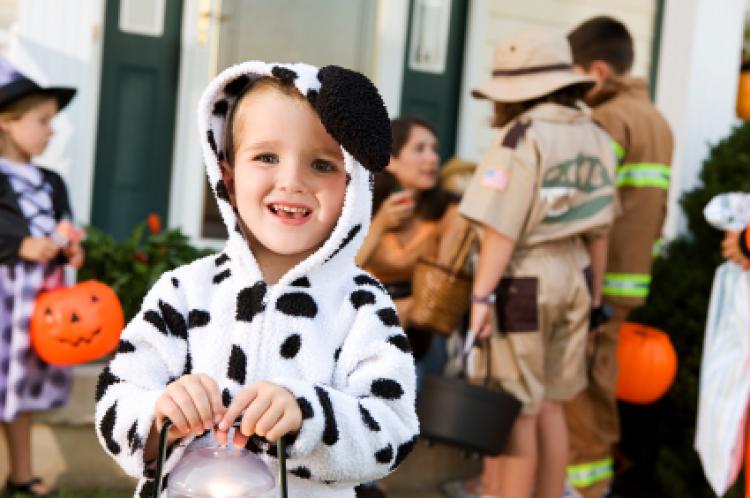
¿ Es el día de los muertos el igual que halloween ?
At first glance, the Mexican custom of the Día de Muertos — the Day of the Dead — may sound much like the U.S. custom of Halloween. After all, the celebration traditionally starts at midnight the night of Oct. 31, and the festivities are abundant in images related to death.
But the customs have different origins, and their attitudes toward death are different: In the typical Halloween festivities, which are of Celtic origin, death is something to be feared. But in the Día de Muertos, death — or at least the memories of those who have died — is something to be celebrated. The Día de Muertos, which continues until Nov. 2, has become one of the biggest holidays in Mexico, and celebrations are becoming more common in areas of the United States with a large Hispanic population.
At first glance, the Mexican custom of the Día de Muertos — the Day of the Dead — may sound much like the U.S. custom of Halloween. After all, the celebration traditionally starts at midnight the night of Oct. 31, and the festivities are abundant in images related to death.
But the customs have different origins, and their attitudes toward death are different: In the typical Halloween festivities, which are of Celtic origin, death is something to be feared. But in the Día de Muertos, death — or at least the memories of those who have died — is something to be celebrated. The Día de Muertos, which continues until Nov. 2, has become one of the biggest holidays in Mexico, and celebrations are becoming more common in areas of the United States with a large Hispanic population.
Its origins are distinctly Mexican: During the time of the Aztecs, a month long summer celebration was overseen by the goddess Mictecacihuatl, the Lady of the Dead. After the Aztecs were conquered by Spain and Catholicism became the dominant religion, the customs became intertwined with the Christian commemoration of All Saints' Day.
Specifics of the celebration vary with region, but one of the most common customs is the making of elaborate altars to welcome departed spirits home. Vigils are held, and families often go to cemeteries to fix up the graves of their departed relatives. Festivities also frequently include traditional foods such as pan de muerto (bread of the dead), which can conceal a miniature skeleton.
Here is a glossary of Spanish terms used in connection with the Day of the Dead:
el calavera — a reckless fellow
la calavera — skull
la calaverada — crazy, foolish behavior
el difunto — the departed
la hojaldra — a bread for the Day of the Dead
la ofrenda — an offering left for the souls of the dead
zempasúchitl — the traditional name for the yellow marigolds used to mark a pathway to the altar
el calavera — a reckless fellow
la calavera — skull
la calaverada — crazy, foolish behavior
el difunto — the departed
la hojaldra — a bread for the Day of the Dead
la ofrenda — an offering left for the souls of the dead
zempasúchitl — the traditional name for the yellow marigolds used to mark a pathway to the altar

MEXICAN SKULLS
MEXICAN TRADITION
Literary skulls are a Mexican tradition related to the Day of the Dead in which rhyming verses by express burlesque way some aspects of personality or defects of the person in a satirical way. Yet despite its wide dissemination in Mexico today, its origins appear at the end of the Viceroyalty.
Literary skulls are a Mexican tradition related to the Day of the Dead in which rhyming verses by express burlesque way some aspects of personality or defects of the person in a satirical way. Yet despite its wide dissemination in Mexico today, its origins appear at the end of the Viceroyalty.

Ray te dejo una dirección de internet sobre los orígenes de Halloween en español por si alguien quiere practicar un poquito.
Ray I let you an internet direction about halloween's origen in Spanish. If someone wants to practice a little
Dulce - candy
Halloween is not so popular in the land of O Z.
Halloween no es tan popular en la tierra de O Z.

We like to start them young though.

En el área de Chicago, chicos rocian crema de afeitar a todas partes y lanzan los huevos a los coches.
In the Chicago area, kids spray shaving cream everywhere and throw eggs at cars.

Halloween in the U S is a time for "trick or treating.
Trick-or-treating—going from house to house in search of candy and other goodies—has been a popular Halloween tradition in the United States and other countries for an estimated 100 years. But the origins of this community-based ritual, which costumed children typically savor while their cavity-conscious parents grudgingly tag along, remain hazy. Possible forerunners to modern-day trick-or-treating have been identified in ancient Celtic festivals, early Roman Catholic holidays, medieval practices and even British politics.
Trick-or-treating—going from house to house in search of candy and other goodies—has been a popular Halloween tradition in the United States and other countries for an estimated 100 years. But the origins of this community-based ritual, which costumed children typically savor while their cavity-conscious parents grudgingly tag along, remain hazy. Possible forerunners to modern-day trick-or-treating have been identified in ancient Celtic festivals, early Roman Catholic holidays, medieval practices and even British politics.