
Poder fáctico
Around 40 years ago, when Franco had finally died and the current Spanish state was beginning to take shape, the above was a current phrase used mainly of the army but also of the church.
However it is far from easy to render well in English.
My first attempt is "malevolent, hidden power-broker" which obviously has elements of precis as well as of translation.
Any offers?
Gracias.
2 Answers
Los "poderes fácticos" in English translate to "the powers that be."
"El poder fáctico", is the "real" or "actual" power. "Fáctico" is a cognate of English "factual."
When we speak of the "real" or "actual" power, we're speaking of an unseen power that is capable of exercising more force than the government. In the United States, The "Bilderbergers" could be seen as a "poder fáctico" --at least that is thought by many.
So how about de facto power?
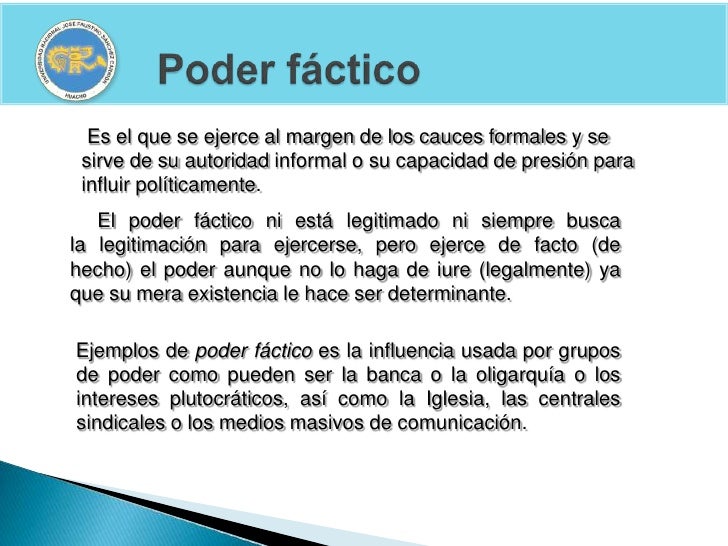
Many thanks for your observations Daniela and for the very instructive sheet which you append.
However, in terms of the suggested translations, I am less convinced:
Your first suggestion, "the powers that be" certainly doesn't make the cut for me as it is an extremely wishy-washy term and carries no menace whatsoever. Yet the expression in Spanish does carry menace. A very real menace 40 years ago, as the night of 23F, nearly a decade later, subsequently proved.
"De facto power" whilst better, still fails to combine the elements of decisive but hidden influence which is needed in the translation, I feel.
"Sorry."
Addendum:
A crucial element within this usage was/ is the concept of a hidden power of veto over the outcomes of the negotiations involved.

















