Rules for memorizing verb tenses
Hola amigos
I am wondering if is there a rule, tips or tricks for memorizing the conjugation of verb in different tense or we just simply have to memorize it by heart ?
Thanks
3 Answers
Ultimately you need to use them enough that they come out naturally, automatically. In the short term there are tips that help you think them through (too slowly for conversational use) while you try to make them automatic.
There are way too many tips out there to put them all in one answer.
An example is future and conditional.
They share the same 12 irregular stems (keep in mind compounds of those verbs will follow the same pattern- eg contener and mantener follow tener)- all others uses the infinitive as the base.
For five replace the vowel before the r with a d
poner pondr-
valer valdr-
salir saldr-
venir vendr-
tener tendr-
For five simply take out the vowel before the r
caber cabr-
haber habr-
querer querr-
saber sabr-
poder podr-
Two irregulars to memorize.
decir dir-
hacer har-
For conditional- use the same endings as for the er and ir forms of the conditional
Conditional Endings:
ía, ías, ía, íamos, íais, ían
For future, the endings are the same as the conjugation of haber in the present indicative, without the h, accented on the first vowel (except with habéis- drop the hab):
he- é
has- ás
ha- á
hemos- emos (no written accent needed as it has a second syllable)
habéis- éis
han- án
So I will have is tendré for example, I will speak hablaré, I would speak hablaría.
It is mainly the present indicative and preterite that need some memorization, but there are still patterns.
Hello Dang,
Welcome to the SpanishDict forum 
You asked:
Rules for memorizing verb tenses Hola amigos I am wondering if is there a rule, tips or tricks for memorizing the conjugation of verb in different tense or we just simply have to memorize it by heart ? Thanks.
I am not aware that there are any actual rules for memorizing verb forms, although tehre may be some common guidelines for learning them!
Daniela, our native Spanish teacher will be able to to tell you whether she is aware of any such rules / whether any such rules exist.
I can offer you a few tips for what they are worth!
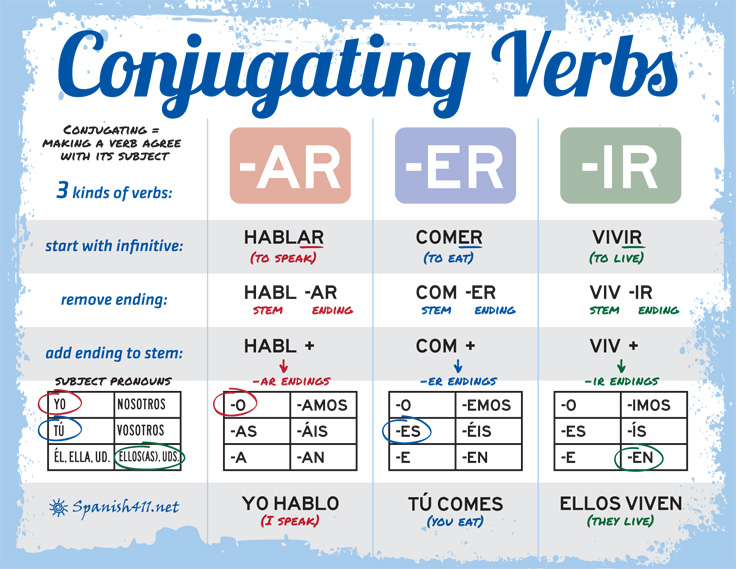
1 Start learning some of the regular verbs eg: hablar, (to speak/talk) trabajar, (to work) comer, (to eat) and vivir (to live) first before learning the irregular ones such as ir = to go or tener = to have (own/possess) You will need to learn these too but I recmmend that you start with the regular ones so that you can familiarise yourself with the patterns of regular ar, er and ir verb endings!
2 When you are learning a verb tense practice writing lots of examples of sentences using that tense This should help you to practise conjugating (forming) them correctly
eg Hablo = I speak/I am speaking hablas = You speak (familiar form used wth friends and family ) hablamos = we speak
Hablo con mi mejor amigo = i am speaking with my best friend.
Hablan con su padre =They speak /are speaking to (with) their father
Alternatively, as you gain confidence you can memorize them by speaking them aloud!.
By the way, this is how I learnt them, by memorizing them by heart with a friend! I had just completed an o' level (basic) Spanish course many years ago in my early 20's and had met a medical doctor on the same course and we became good friends. He suggested that we continue to meet up once a week to practise learning our Spanish together He also wanted me to help him learn the verbs so we learnt how to conjugate the main simple verb tenses: present, future, conditional,, imperfect and preterite (simple past) Sadly he died from a heart attack not long after, so we were unable to continue learning together!
I hope this helps
Inasmuch as each simple verb tense has six forms, that is six for AR verbs Six for ER, and IR verbs, They are easy to memorize. You just do one tense at a time. Just pick a regular verb, any regular verb, and go over it about 10 or 15 times, and you have just learned the rest of all the regular verbs of that particular conjugation. (AR, ER, IR, etc)
In classes we spend a lot of time on the present tense of regular verbs, then move on to the irregular verbs, with stem changes and other irregularities, then we move on one by one to the other tenses.
The forms are quite easy. Most of my students that follow my instructions get them very quickly.