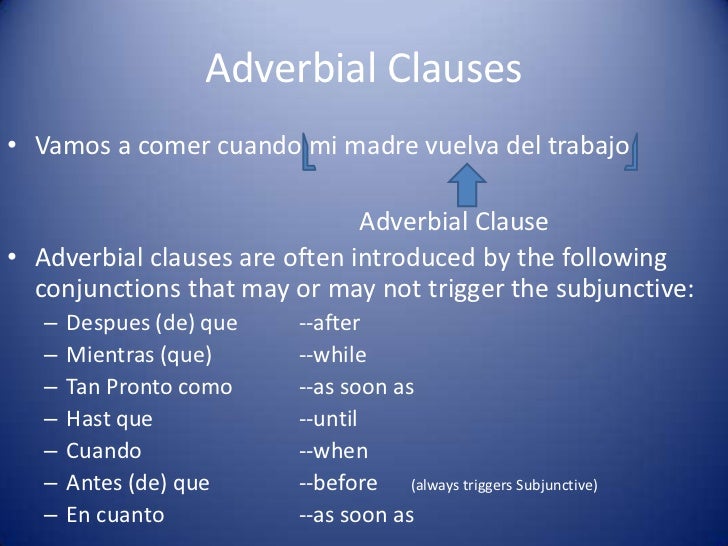
Same subject subjunctive conjunction of time
Hi everyone, I just learned the subjunctive conjunctions and I'm a little confused with what to do when there is no change in subject. My teacher is going to quiz me on Monday and she is going to grade the quiz based on the newest real academia española grammer rules.
I understand that with escapaa (en caso de que, sin que, con tal de que, antes de que, para que, a menos que, and a fin de que), when there is no change of subject, I take out the que and use the infinitive. Example: Estudiaré para pasar la prueba
The only exception is a menos que because a menos is not a preposition. What I don't understand is the conjunctions of time like en cuanto, cuando, tan pronto como, después de que, and hasta que. If I wanted to say "I will study until I am hungry", would I use hasta + infinitive? How about "I will study when I get home" and "I will study as soon as I get home"?
Lastly, does the same subject rule apply to commands? Like if I said, "close the door before you leave", would that be the same subject? How would I say close the door before you leave using the informal tú command?
Thank you so much. I appreciate your time reading this and helping me.
1 Answer
When using these conjunctions, the subjunctive always follows, regardless of the lack of change of subject.
Cuando (yo) llegue a casa voy a quitarme la ropa, ponerme el pijama, comer y ver la tele.
I will study until I get hungry. Estudiaré hasta que tenga hambre. Estudiaré así que llegue a casa.
With the commands, you can use either the subjunctive or the infinitive. (The infinitive is more common)
"Cierra la puerta antes de salir." (infinitive) "Cierra la puerta antes de que salgas." (subjunctive) the "antes de que" is the "trigger.'
There is one mistake in the following chart--"hasta" is misspelled.
Remember if the action has not yet occurred, use the subjunctive.