
English - The Universal Language?
As you all know I have been living in Mexico for the past eight years. I live day to day in Spanish as no one in my Mexican family speaks English, even though they have a fairly large English vocabulary. I have many Mexican friends and most speak very little English. Occasionally I get the chance to meet and speak for extended periods with native speakers from other parts of the country. This past week I was out sailing with a couple from DF. They both are bi-lingual and fluently so. We spoke about languages quite a bit as the husband works in international finance and deals with people of many languages. He told me that almost all international business in DF is conducted in English. When I asked why he stated that it was because of the ease of learning English vs most other languages of the world, including Spanish. Here is Baja California Sur , at least in La Paz, we do not have an overwhelming English language presence., yet new English words are constantly entering into the vocabulary of the populace. For example., hotspot is hotspot. The Spanish equivalent, lugar caliente carries just too many double entendres to every be accepted. There are others that are gaining common acceptance as well Oh my God and Ok being two others. English is now taught in public and private schools from kindergarden on.
So what are your thoughts on this? Are we in an age of reverse Tower of Babel? Will English be the new world language in a hundred years?
7 Answers
I understand Danish - I understand therefore Norwegian and Swedish without too many problems.
These languages have even more simple verb conjugations than English - as Jubilado mentioned above this makes these languages easier to learn than say Spanish.
Sometimes it seems to me that Spanish - and the other Latin languages - were invented by a committee whereas English just developed as people used it and accepted any influence from "foreign" languages it came into contact with.
Right now there are more people learning English all over the world than there are native English speakers.
The "universal" language is English and today there many times more speakers of English who have their own "first" language than there are native English speakers.
This also means there is no longer a "standard" English that should be promoted especially because about 4000 new words are officially added to the English language every year.
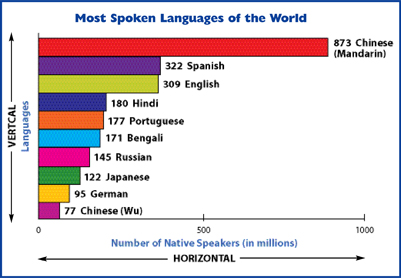
Actually Mandarin Chinese has more than double, almost triple the native speakers in the world. But English is definitely the most used universal business language everywhere I've travelled and very common as the 2nd language taught in schools.
En mi larga vida percibí el avance de la lengua inglesa , porque en nuestro país , siendo por muchos años el imperio Austro-húngaro, la lengua franca fue el alemán pero eso se cambiado porque a pesar de la vecindad de Austria y las conexiones con Alemania la lengua ajena más importante es la ingles.
La lengua húngara es muy diferente de la lengua inglesa y por eso no tan fácil estudiarlo y por mala suerte la enseñanza no es la mejor. Esperamos que tarde o temprano en nuestro país la gente vaya a hablar ingles como en Holanda.
In my long life I felt the advance of the English language, because in our country, being for many years the Austro-Hungarian Empire, the lingua franca was German but that was changed because despite the vicinity of Austria and connections with Germany the most important foreign language is English.
The Hungarian language is very different from the English language and therefore not so easy to study and the teaching is not the best. We hope that sooner or later in our country people are going to talk English like in Holland.
I just spent two weeks at a jungle retreat in Borneo and although most of the
of the guests were from almost every country in the world the "Lingua Franca"
was English , even for the staff whose language was "Bahasa Malaysia"
This proved to me that English is now the predominant language in the world.
English really has a very simple syntax structure. The verb is relatively easy to use for communication and the Subject Verb Object of simple sentences seems to be natural. English spoken badly can still be understood. The only real challenge for non-native speakers seems to be the spelling. I believe Chinese has an even simpler syntax but the necessity for mastering tones makes it extremely difficult for non-native speakers, and written Chinese is far more complicated that written English.
Some examples of understandable bad English:
No articles: Man eat burger. Man eat burger? Burger no eat man. Was you here? We was. Me no want that. Some languages would not survive such slaughter and come out intelligible!
Maybe it is time for the reverse of the Tower of Babel since we've already penetrated the heavens.
In addition to what everyone else has said and to avoid repetition, just want to add that English accepts new words from any language of people who happen to be near. Mexico is near to California and so we have had hundreds of Spanish words coming into the English language such as nada, macho, taco, (and a bunch of other foods) patio, fiesta, calaboose (calabozo) lariat (la reata) and many many others,
There has also been a flood of English words and grammatical expressions finding their way into Spanish. I will discuss a few.
"Textear" "Surfear el internet" Surfear is no way a Spanish verb. Just to talk about ocean surfing, the proper Spanish used to be "correr las olas". To TAKE a picture was "sacar una foto" now "tomar" fotos is even included in textbooks. How about "perros calientes"? That is a recent addition to Spanish as well as "donas" (donuts)
One could go on and on, but I just want to contribute my two centavos' worth and see what everybody else has to say.

My wife, from the UK, has an MA in English. We do get into some heated discussions about language, particularly English, with the "British English versus American English." I can get to her, though, when she questions, for example, an American usage of a word. I'll ask her why her version is correct and mine incorrect, and she'll say that the English language "came from" England. Then I very humbly point out how many different languages comprise "English." For some reason, that never goes over well with her.


















