
What are the three steps to conjugate a verb in spanish?
You start with the ____________ (neutral form of the verb- hablar dibujar bailar.)
Drop the _________________ now all you have left is the "stem" of the verb (Habl, dibuj, bail."
- ___________________the appropriate _____________ according to the subject (who you are talking about."
also...... for each of the following pronouns write the correct verb ending.
Yo _____ Maria________ Tú ________ ellos______ marcos y yo______ isabel y tú _________ ella______ él______ mardos y joaquin ______ usted________ Thanks!
4 Answers
You want us to do your homework!!!!!!!!????????????
Edit:
I really would like to know how many new users are generated each day in this site.
I don't think it is a coincidence all these little people are trying to get their homework done and making us think they don't know any better.
It will continue to happen that way because of people like Daniela and her granny's heart that they get their answers and can score nicely at school.
If these numbers of "users" is what the people at this site are thrilled at, then I don't know who is fooling who.

Other than that I really don't have a problem. Just tell me to stop answering to that type of questions one way or another and I'll do it.
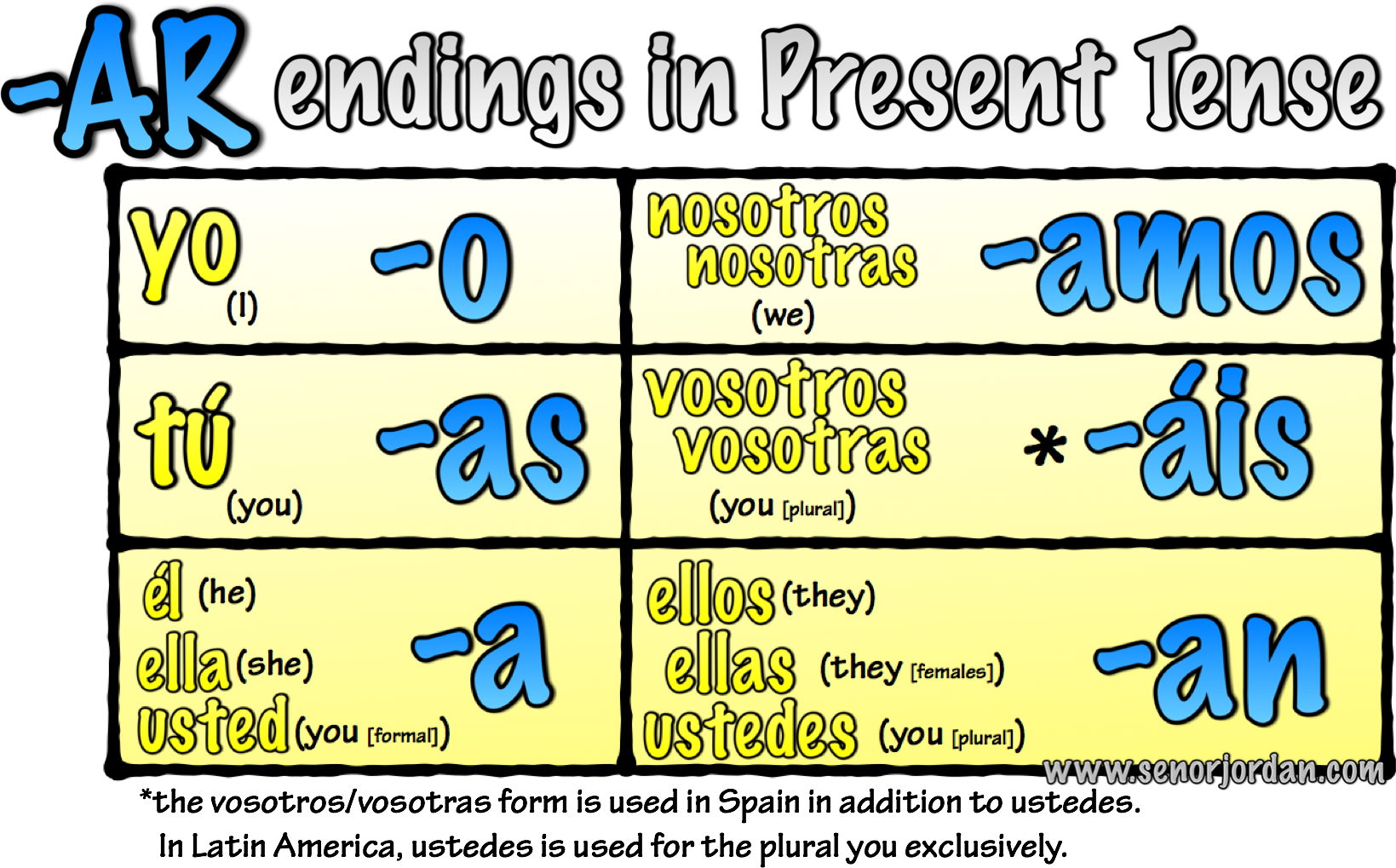
I am sure that your teacher has taught you a lesson from your textbook on this subject. Did you pay attention? No? OK The verbs you have given are called "ar" verbs-- and for a reason. The infinitive ends in "ar" The first thing you do when conjugating a verb is to remove the "ar" infinitive ending and replace with "personal endings." The personal endings follow.
You could find these endings in your book but I will put them here.
Yo------------------o
tú-------------------as
él/ella/Usted/--a
Nostros----------amos
Vosotros--------áis
ellos/ellas/Uds--an
Now that I have answered your question, (at least in part--you still have to fill in the blanks.) could you please do me a favor and fill out your profile?. It is really necessary so that the members can understand what your levels of Spanish and English are and how to approach your question. As a Spanish teacher, I know exactly where you're coming from, but it's not so obvious to those who aren't dealing with close to around 100 students every day who ask similar questions all the time.
As Gringo said, it´s not called "the neutral form of the verb" but simply infinitive.
As far as these "3 steps" are concerned, until you acquire a feeling for conjugations all you have to do is search for the infinitive of any verb on a conjugator for person, tense, and case, and use the result. And at your stage, it looks like you only need to be concerned with present simple tense, so go now and do your homework.
Your teacher´s discription for me seems very convoluted. I would first find a different teacher and then drink the beer.
Drink a beer. Drink another beer. Use the infinitive.
Sorry just joking around.
This is homework so try it yourself first.
Not the beer drinking unless you are of age.
















