
Help having a hard time conjugating!
I am having the hardest time using the verbs ser and estar, and conjugating, need some tips on making this easier.
5 Answers
Practice and don't give up. Ser is (for me) very hard to remember all the tenses. You just have to memorize them and then use them enough to stick in your head.
Learning to conjugate verbs in Spanish was hard for me too. They change more in Spanish than they do in English, so there is a lot to memorize. A suggestion, make a list of common irregular verbs (like ir), and you just have to memorize how to conjugate them. You can divide the regular verbs in to the three groups, ar, er and ir, and learn the formula for each type of ending and each tense. I used to write a few on the inside of my arm or palm and then do memory drills while running or other such activities. Ser vs. estar is hard to get at first, but just give it some time to sink in.
If you are not going to use your Spanish in Spain (if you live in the Americas, for example), you can skip learning the vosotros form. This will give you one less to memorize.
I think Notedstrangeperson's suggestion of using a table is a very good idea.
If you make up a grid on paper like the example she gives and actually hand write the verbs in it for each verb that you are learning it will help reinforce your memory. Sometimes it helps putting pen to paper.
If you have a small whiteboard you can make the grid and fill it in then use the "disappearing" information method by going over it and erasing one or two each time until you have a blank grid and the forms are now in your head.
I try to make a table or grid.
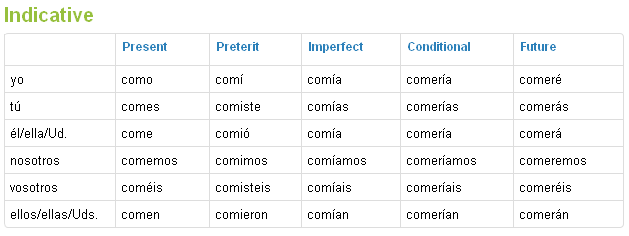
All the columns have the tenses (present, preterite, imperfect, conditional and future). All the rows have the persons (I, You, He / She, We, You [collective] and They). That way, if you look carefully, you'll start noticing patters. For example:
- Most conditional -AR verbs end in "-aba".
- Most nosotros (we) -AR conjugations end in "-mos"
So if you combine the two, you'll get estarábamos ("We would be").
This method isn't perfect because there aren't always patterns and some verbs are irregular, but it's a good way to start.
Here is the grid for an -ER conjugation. Notice how all the imperfect tenses end in "-ía". Similarly all the vosotros conjugations end in "-is". So if you combine the two you get comíais.
Good luck.

















