
An introduction to the present subjunctive - a little help
If you struggle with the concept of the subjunctive mood in Spanish I hope that this simple lesson might get you started on understanding one of the more complex parts of Spanish Grammar.
This link introduces you to the present subjunctive, how to form it and two situations where you will need to use it. I'll gradually add more situations to the post so that your knowledge can grow without (hopefully) overwhelming you.
Please feel free to ask any questions on the topic here.
7 Answers
I did this lesson and found it a wonderful help , but it did point out
to me that my grounding in conjugating verbs is poor. I need to do
far more work on being able to conjugate as many tenses as possible .
Thank you Kiwi , champion teacher! I like the Kiwi in the cup , do you
have any inside knowledge ?
Great article, once again! Thanks a lot, Kiwi!! Also for gradually expanding the info 

For anyone following this thread who would like to familiarise themselves little by little with the classic situations where you should use the present subjunctive here's the latest update ...
As you know we started with 'Situations 1 & 2'
Situation 1:
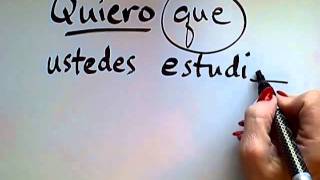
When one person wants or doesn't want another person to do something in the future the present subjunctive is used in the following sentence construction:
Querer + que + verb in the present subjunctive
or
No querer + que + verb in the present subjunctive
Situation 2:
When the word cuando (when) is followed by a future or anticipated event it is followed by the present subjunctive:
Cuando + verb in the present subjunctive
Now I have added 'Situation 3':
When any phrase meaning 'as soon as' is followed by a future or anticipated event then the present subjunctive is used. This includes 'en cuanto', 'tan pronto como', 'nada más que' and 'luego que' etc.
Thanks to everyone for your kind comments, I'll update this post whenever I add some new subjunctive situations. Or if you have any specific ones, that you see a lot and have wondered about, just let me know and I'll write a wee lesson to match.

Thanks for this post, Kiwi, it is very helpful.
Timely for me. You have the art of simplifying diffiulties down pat. Thanks.
I added a link for a flashcard set I found done by Skyline_TL that gives us more practice in the irregulars that Kiwi's lesson talked about.
Subjunctive irregulars flashcard set to practice
Presenting it slow, 2 at a time is more doable for me. When it's presented this way, I can take it in. Thanks for sharing.
Great job, Kiwi!

















