
Learn Words Through Today's News: Protests in Spain
Today, we are back in the Madrid streets with the demonstrations. El País is also back to describe what is happening, and they are using lots of curious words and colorful phrases that can help us learn Spanish.
Here is how this works.
I will post a headline and a couple of paragraphs from a Spanish-language newspaper. You will read through it for comprehension. When you find a word that you don't know, (and I know that sometimes I cannot even make it through the headline) click on it or look it up in the translator or dictionary. Then, post that one word in Spanish and English, and the definition as your entry. You can post a picture if you like. Any words you provide definitions for, please highlight that word.
If enough people participate, we will have lots of tricky words and phrases spelled out for us, will add to our vocabularies, improve comprehension and be up to making light conversation on current events in Spanish at cocktail parties.
You can translate phrases and sentences if you like.
By the end of the day I create a flashcard set of the day's words so circle back and look for the link. Then you can test your recall of the vocabulary words and phrases from today's news.
Click here for today's flashcards.
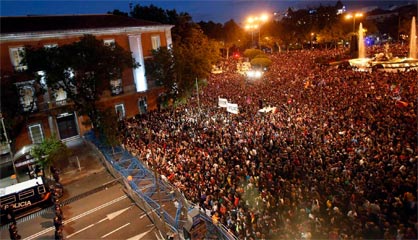
Miles de manifestantes acuden a la convocatoria contra los recortes en los aledaños de las Cortes
La policía ha desalojado a los últimos concentrados en la plaza
La protesta se salda con dos manifestantes detenidos y 13 heridos, uno de ellos policía
"La violencia del otro día es intolerable”. “¿Qué espera el Gobierno, que no protestemos con las decisiones que están tomando? ¿Hay que quedarse en casa callado con todos los recortes que están haciendo y cinco millones de parados?” “Es increíble que el presidente diga que a él lo que le gusta son las mayorías silenciosas. Es una frase autoritaria”. En los corrillos que se han formado en la tarde de este sábado en la manifestación de la madrileña Plaza de Neptuno -la tercera en una semana bajo el lema Rodea el Congreso- se habla de política. De recortes, de Rajoy, de los presupuestos recién presentados por el Ejecutivo español, de los Presupuestos del socialista François Hollande... Miles de personas, estudiantes, jubilados, trabajadores con niños, parados... han protestado a 200 metros del Congreso de los Diputados, cuando la Cámara no estaba reunida, por la política económica del Gobierno.
Hacia las 23.30 los convocantes dieron la marcha por terminada, pero algunos decidieron quedarse. La policía empezó a desalojar, a desplazarlos. Unos descontrolados lanzaron latas a los furgones. Se produjo algún choque, aunque menor. Los agentes empujaron a los últimos a irse. Y poco a poco, decidieron marcharse. Hubo dos detenciones y se registraron trece heridos, uno de ellos policía.
Montse Fernández, Silvia Llopis y Vanessa Fernández. / M. C. Algunos asistieron a la manifestación del día 25, que acabó con graves altercados, cargas policiales y 36 personas detenidas a las que una juez ha imputado de forma genérica delitos de atentado, resistencia y contra las altas instituciones del Estado (a todos salvo a dos, uno de ellos menor de edad). Otros no vieron lo que pasó ese día más que por las cámaras de televisión. En cualquier caso, hay una idea repetida: los manifestantes expresan indignación por la actuación policial, por las declaraciones posteriores del Gobierno afirmando que la intervención había sido “extraordinaria”, “espléndida”, “brillante” y “ejemplar”, y también se muestran ofendidos por las palabras de Mariano Rajoy en Nueva York.
El presidente del Gobierno hizo un “reconocimiento” a “la mayoría de españoles que no se manifiestan, que no salen en las portadas de la prensa y que no abren los telediarios”. “Esa inmensa mayoría está trabajando, el que puede, dando lo mejor de sí para lograr ese objetivo nacional que nos compete a todos, que es salir de la crisis”, dijo Rajoy. Muchos manifestantes aseguraban que esas frases les han hecho salir a la calle. “Me sentí insultada, y venir aquí es mi respuesta”, afirma Isabel Martínez, una abogada de 38 años. “Considero que el sistema no funciona, que las listas cerradas no me permiten elegir a los representantes que quiero, que las promesas electorales no se cumplen, y que el Gobierno ayuda más a los bancos que a las personas. Diga lo que diga Rajoy, no me voy a callar”.
Isabel Martínez. / M. C. “Esas palabras fueron un error garrafal”, coincide Juan Alcudia, de 74 años, jubilado. “No puede ofender así a la ciudadanía que se manifiesta pacíficamente”. “Un poco de respeto, por favor”, dice Montse Fernández, de 38 años, que ha acudido a la manifestación con su hermana Vanessa y con una amiga. “¿Quién es este señor para juzgarme por asistir a una manifestación? Yo soy una ciudadana de bien, madre trabajadora, pago mis impuestos y me manifiesto precisamente porque me preocupa mi país. Porque quiero que mi hijo de dos años tenga un futuro y porque no me gusta lo que está haciendo el Gobierno. A Rajoy no le vendría mal salir un poco a la calle y ver lo que está pasando. Parece que los políticos están en otro mundo. Nos ha costado muchas décadas conseguir los derechos sociales que teníamos, y no vamos a presenciar cómo se disipa todo sin protestar”.
10 Answers
Miles de manifestantes acuden a la convocatoria contra los recortes en los aledaños de las Cortes.
manifestantes - protestors
acudir - to go; to come; to show up; turn out
la convocatoria - call (to action)
los recortes - (budget) cuts
los aledaños - areas adjacent to, outskirts, outside
las Cortes - Spanish Parliament
Thousands of protestors turn out for the call against the budget cuts outside of the Spanish Parliament.
presenciar
transitive verb = to be present at (asistir); to witness (ser testigo de)
Nos ha costado muchas décadas conseguir los derechos sociales que teníamos, y no vamos a presenciar cómo se disipa todo sin protestar”.
It has taken us many decades to obtain the social rights we're having and we are not going to stand by and watch without protest how all this disappears.
el corrillo -- small circle of people, huddle, clique
desalojado - desalojar - to evict
La policía ha desalojado a los últimos concentrados en la plaza.
The police took away the last few protesters from the square.
¡Gracias, francobollo!
aseguraban - claimed - maintained
Muchos manifestantes aseguraban que esas frases les han hecho salir a la calle.
Many demonstrators claimed these phrases made them take to the streets.
New word: Garrafal
“Esas palabras fueron un error garrafal.”
Those words were a monumental mistake.
This is great! Where do you find the flash cards for it?
This is exactly what I'm looking for as I need to increase my vocabulary
desalojar - to evict; to remove, to evacuate, to expel
la lata - the can, the tin
el furgón - the van
desplazar - to remove, to displace, to force out
descontrolado - Wild, undisciplined, irritated
La policía empezó a desalojar, a desplazarlos. Unos descontrolados lanzaron latas a los furgones.
The police began to expel them and to force them out. Some of the irritated/exasperated (unruly?) people threw cans at the vans (police vans?).
I think bottles and rocks are the traditional out-of-control methods many unruly crowds use, but it says "latas", so I guess they are throwing cans.
“¿Quién es este señor para juzgarme por asistir a una manifestación? Yo soy una ciudadana de bien, madre trabajadora, pago mis impuestos y me manifiesto precisamente porque me preocupa mi país. Porque quiero que mi hijo de dos años tenga un futuro y porque no me gusta lo que está haciendo el Gobierno."
juzgarme -- to judge me
cuidadana/o -- citizen
Who is this man to judge me for assisting in a demonstration? I am a good citizen, a working mother, I pay my taxes and I demonstrate precisely because I worry about my country. Because I want my child of two years to have a future and because I don't like what the government is doing.
"La violencia del otro día es intolerable”. “¿Qué espera el Gobierno, que no protestemos con las decisiones que están tomando? ¿Hay que quedarse en casa callado con todos los recortes que están haciendo y cinco millones de parados?” “Es increíble que el presidente diga que a él lo que le gusta son las mayorías silenciosas. Es una frase autoritaria”.
"The violence that took place the other day is intolerable". What does the government expect with the decisions they are making? Should we stay quietly at home despite all the cuts they are making and five million people unemployed? "It's ironic how the President says what he really likes is silent majorities. It's an authoritarian phrase."


