
Latin America Challenge 9
Have you ever eaten hominy, also called nixtamal or maíz pozolero? Today you can buy it in a can at many grocery stores in the USA. It's origins, however, go back at least 3200 years to Guatemala and Mexico. Various indigenous American cultures still make it by treating & cooking whole corn with an alkaline solution, often a lye solution. In the process, the hulls of corn are removed making the kernels easier to grind into flour. In addition, the nutritional content actually improves, as well as the resistance to fungus.
The treated corn can be eaten in that form, combined with other ingredients to create stews and soups such as pozole or ground into flour for masa which can be used to make tortillas, enchiladas and other foods, and drinks like atole.
.JPG/220px-Hominy_(maize).JPG)
Today's challenge: Tell us about a favorite food with Latin American origins. Include a photo, a recipe or any interesting facts about it. Use whatever resources you have available. Please post only one food per response, but feel free to post as many times as you like. And try some hominy!
11 Answers
[link text][1]
[1]: 
These are called Salteñas.
Very popular in Bolivia.
They can contain beef or chicken and be Sweet (dulce) or Hot (Piquante)
The first time you try to eat them have a look at how the locals do it.
If you don't you WILL make a mess of it.
Salteñas
FILLING Ingredients: for 50
1 cup lard or margarine
1 cup ground spicy red pepper (cayenne) mixed with water
½ tablespoon ground cumin
½ tablespoon black ground pepper
½ tablespoon crumbled oregano
1½ tablespoon salt
2 cups white onion, cut into small cubes
1½ cups green onion, finely chopped
3 pounds lean meat, cut into small cubes
1 cup potato, peeled, cooked, and cut into small cubes
½ cup cooked green peas
¼ cup granulated sugar
½ tablespoon vinegar
½ cup parsley, finely chopped
2 spoonfuls unflavored gelatin dissolved in 3 cups water
½ black olive per salteña
3 raisins per salteña
1 slice of boiled egg per salteña
Preparation:
In a casserole add the margarine and the spicy red pepper. Set to boil over high heat until the margarine separates from the pepper. Next add cumin, ground black pepper, oregano, and salt. Let cook for ten minutes over low heat so that the mixture does not stick. Stir constantly. Next add the white onion and let it cook for five more minutes. Finally add the green onion.
Remove the casserole from the heat, add the sugar, vinegar, parsley, potato and cooked peas.
In another casserole add the three gelatin cups. Let it cook over high heat and as soon as it starts to boil, add the meat. Mix quickly and remove from the heat.
Mix the first preparation with the gelatin and meat. Let it cool in the refrigerator one night or until it thickens. If wanted, add the olives, raisins and egg before it thickens or add them directly on the dough when preparing the salteñas.
Many Guatemalan children drink "atol" for breakfast, which is a masa (corn hominy flour), agua, azúcar, and canela.
Every morning I can hear the molido machine grinding the corn to make it into a masa, which is then used for tortillas...hundreds and hundreds a day!

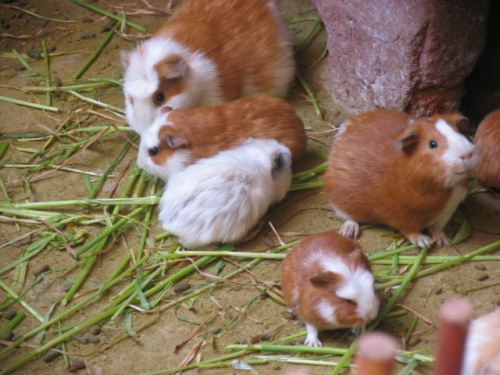
Cuye
The guinea pig plays an important role in the folk culture of many Indigenous South American groups, especially as a food source, but also in folk medicine and in community religious ceremonies. Since the 1960s, efforts have been made to increase consumption of the animal outside South America
Guinea pigs (called cuy, cuye, curí) were originally domesticated for their meat in the Andes. Traditionally, the animal was reserved for ceremonial meals by indigenous people in the Andean highlands, but since the 1960s it has become more socially acceptable for consumption by all people. It continues to be a major part of the diet in Peru and Bolivia, particularly in the Andes Mountains highlands; it is also eaten in some areas of Ecuador (mainly in the Sierra) and Colombia.
Guinea pig meat is high in protein and low in fat and cholesterol, and is described as being similar to rabbit and the dark meat of chicken.The animal may be served fried (chactado or frito), broiled (asado), or roasted (al horno), and in urban restaurants may also be served in a casserole or a fricassee.Ecuadorians commonly consume sopa or locro de cuy, a soup dish. Pachamanca or huatia, a process similar to barbecueing, is also popular, and is usually served with corn beer (chicha) in traditional settings.
Chicha

Chicha the drink of the Incas
In Bolivia chicha is most often made from maize but amaranth chicha is also traditional and popular. Bolivian chicha has alcohol
Visitors to Latin America will, at some point in their travels, come across a traditional drink called chicha, a type of fermented beverage common in the region.
Chicha, a pale yellow, milky drink common throughout Latin America, originated with the Incas, who used the drink during festivals and other rituals.
Nowadays, chicha remains an important part of the region’s indigenous past, and can be found in a variety of settings, from the dinner table to a wedding or baptism! Chicha, the fermented beverage usually created from corn, was not consumed until after these people had eaten.
Typically, they ate twice a day, then drank their chicha. Chicha is weakly alcoholic so in regular quantities would not be notably inebriating. However, at some festivals, massive amounts might be consumed.
Chicha, however, is the Spanish name for this beverage. The ancient Peruvians spoke Quechua, a language still extant. In the altiplano (low country) they spoke Aymara.
In Quechuan, the name for chicha is aqa (or, a'kha).
In Aymaran, the name is kusa.
The Spanish name comes from their word for "to spit" ("chichal"). This didn't mean they didn't necessarily like it, but refers to the means by which this drink was produced.
I posted this in another thread, but thought I would add the same recipe for your challenge. 
The recipe is for mangú. This is a typical dish eaten here in La Republica Dominicana. It is very inexpensive and requires only a few simple ingredients. I have cooked it once with success already. At least that's what the locals claim, but who knows if they would be honest. 
There is one story that claims that when American servicemen asked for mashed plaintains in Santo Domingo, they would say "Man this is good!", which was later shortened to its current name. Others claim the name is African in origin.
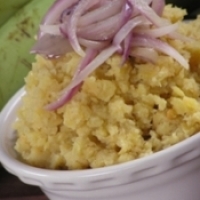
Please pardon my spanish, I'm trying, but I'm not very good at it yet, and I don't know how to download pictures. Thank you.
¡No, gracias, no me gusta hominy! Pero, aquí es una receta para sopa de concha y es muy deliciosa!
Conch Soup (originated in Honduras)
1 pound of conch, peeled and cut in small pieces 2 shredded coconuts 3 green bananas 2 carrots 2 pounds of yucca - it is better if you use yellow yucca 2 garlic teeth 2 large onions - yellow or white 2 green peppers 2 bouillon cubes 1/2 cup of coriander - small leaf 1/2 cup of coriander - broad leaf 1/8 cup of margarine 1 cup of coconut milk
Process: Cut up onions, garlic, green peppers. Peel and cube all vegetables (except the bananas) and fry them in the margarine. Add bouillon cubes andcoriander. Blend together the meat and the coconut milk. Sift mixture - you may need to add some water to get approximately 3/4 liter of coconut milk. Add this to the fried vegetables then let simmer @ 15 to 20 minutes. Add the bananas and simmer for another 7 minutes or until the bananas are soft. Add the conch and let it simmer for five more minutes.
SOPA DE MANI

INGREDIENTES:
1/2 pollo cortado en pedazos pequeños
300 grams maní pelado y molido
1 cebolla mediana y pelada
1 apio cortado
3 zanahorias medianas peladas y cortadas
2 papas grandes cortadas en 4
1/2 cucharadita de azafrán
1 cucharadita de orégano o perejil picado
PREPARACION:
En una cacerola colocar todos los ingrediente menos el maní y la papa, hervir a juego medio por unos 45 minutos luego agregar el maní y cocinar a juego lento por una media hora, luego agregar las papas peladas y cortadas en 4 y dejar cocinar hasta que las papas estén bien hechas, apagar el fuego y echar el orégano o perejil picadito.
Servir la sopa con papas fritas encima...............¡ummmmmmmmm que buena!
Api y Pastel

Pastel
Ingredientes
3 Libras de Harina 1 Cuchara de Sal 1/4 Manteca 1 Litro de Agua Caliente
Preparacion:
Mezclar todos los ingredientes y amasar bien con los puños, dejar reposar por 5 a 7 minutos, luego moldear la masa en forma alargada, arrancar y uslerear.
Api
El api es una bebida típica del altiplano andino. En Bolivia, se consume en la zona andina de los departamentos de La Paz, Oruro, Potosí, Chuquisaca y Cochabamba.
La elaboración de esta bebida es en base a los granos de maíz morado y a esto debe su color guindo. La preparación de esta bebida se hace a través de maíz morado molido, azúcar, además algunos tallitos de canela.
Generalmente se sirve bastante caliente para mantener su sabor, aunque también existe una versión fría. Un acompañante para el api es el buñuelo o pastel.
También se sirve mezclado con tojorí.
Tostones are another popular dish here. I am adding this link because in addition to the description of how they are made and used in the D.R., it also provides information on how these fried plantains are cooked and served in other countries like Puerto Rico, Cuba and parts of South America.

Tomatoes.

Tomatoes are native to South America. The word "tomato" comes from the Nahuatl word "tomatl" and means "swelling fruit". The Aztecs and other peoples in the region cultivated tomatoes several centuries before Christ. The Spanish conquistadors brought the tomato to other Spanish colonies, to Europe and the Philippines.
The peanut! Also called earthnut, ground nut, goober pea, monkey nut, pygmy nut and pig nut in English; cacahuete, cacahuate or maní in Spanish; cacahuète in French . It is not a real nut but a legume like peas and beans.

Archaeologists say that the ancient Peruvians ate peanuts 7600 years ago.

















