
Spanglish!
Julian and I were having a discussion about Spanglish in the comments section of another thread. I did not want to hijack that thread so I'm bringing it over here. By Spanglish I mean a mixture of Spanish and English, either moving fluidly between both languages (even in the same sentence), or using made-up words.
What has been your experience with Spanglish?
In my experience (disclaimer: my own experience, not claiming to be an expert, tee hee), Spanglish is spoken by some Chicanos in the US, even educated ones that know Spanish and English, especially in mixed-language company. Also when I was in Mexico (disclaimer: international language school, specialized environment), a lot of young people spoke Spanglish in mixed-language company.
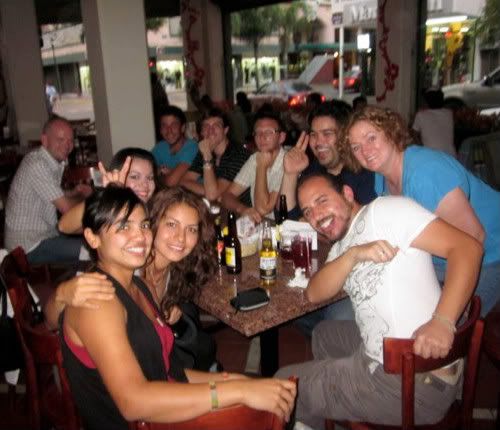
Guadalajara 2010. Having lunch with a fun group of friends. Spanglish was spoken socially. Countries represented here are Mexico, USA, Germany, Sweden, and England. (I'm in blue on the right.)
21 Answers
Against my better judgement, I'll expand the reasons I hate Spanglish.
First, language needs to be precise to avoid ambiguity. I retired from information services and health care. I now volunteer in these disciplines. I can not afford to be misunderstood or provide ambiguous communication. I believe Spanglish invites misunderstanding and ambiguity.
Second, I believe using Spanglish gives the user a false sense of familiarity with the language. By placing Spanish words in sentences constructed according to English rules (and vice-versa), the user never develops the mental mechanism to correctly construct sentences in their non-native language.
Third, I approach all people with respect of their customs and languages, and I appreciate them doing the same with me. It seems disrespectful to me when someone corrupts the language by mixing words and phrases. Maybe it's just me, but I don't consider it polite.
I could go on, I suppose, but those are my primary objections. Social, personal, and business relationships are difficult enough to manage under the best circumstances. I do not need to introduce additional avenues of misunderstanding to compound the difficulties.
I still appreciate your posts and responses.

Happy, I appreciate your posts and responses, but I hate Spanglish. I believe it leads to misunderstanding and ambiguity, while inhibiting the proper development of language skills.
That said, I understand many of my posts appear to be in Spanglish. That is not my intention, but that is the way it comes out. I hope more fluent speakers will correct me when this happens.
I am eager for the day when I can read, write, and speak the Spanish language correctly. I don't want to lull myself into a false sense of security with the language.
That's just my opinion. 
Happy, I appreciate your posts and responses, but I hate Spanglish. It leads to misunderstanding, ambiguity, and the poor development language structural skills.

I couldn't agree more
That said, I understand many of my posts appear to be in Spanglish.
 funny but not true dogwood, but it made me laugh, jeje
You know, there is a language in Hawaii called "Hawaiian Pidgin". Spanglish is basically a form of pidgin (i.e. multiple languages mixed into one), and if you ever go to Southern California, you won't hear anything else in the spanish-speaking community, unless there is a formal event, or a beginner is trying to learn the correct grammar. And even professional singers will use it in their best-selling songs. This language use has even started to spread to a few pieces of American programming and literature.
How large is the language difference? Well..... they will not conjugate infinitives except in the "yo" and "Uds." forms. They also tend to use more slang than any non-native could ever keep up with. After being in Mexico, I must say that Spanglish (although most wouldn't think so) could probably be counted as an actual pidgin language, it is so different.
Don't forget, the Bible was printed into Hawaiian pidgin (Da Jesus Book). People may decide to do the same for Spanglish.
So-Cal all the way!
I can understand the attraction some other people might feel towards using spanglish as a means of social communication but I really cannot take it seriously as a language. I would much rather prefer to learn to speak a language properly and I do wonder whether the message communicated by one person using spanglish is received and understood with the same meaning by the other person hearing it. or does the message become as mixed up as when people play the game Chinese Whispers where the potential for the message to be changed/distorted increases with every person that passes it on
I can't help feeling that the use of this kind of language in social situations will just eventually result in confusion and misunderstanding when the need for discussing serious matters arises.People tried a thing years ago when they tried to introduce a common language and called it Esperanto it failed to take-off
In my view all the time such ridiculous compromises exist they will eventually de-motivate people in learning to speak the other person's language properly ... after all, why bother learning their langauge if you can speak a mixture that makes little sense.
Call it what you will,a mix of language is just that. The phoenicians did it as a way to communicate,so do we. As far as spanglish is concerned,don't let it get in the way of your learning,whether it is english or spanish, it creates vices. Now then---- at a party or a lunch (especially with an international group) it can be humorous and fun. Language is a living thing and will forever change,it is the only constant. We cannot print dictionarys fast enough. Now to back to learning, learn it right that gives you the tools to have fun with the(any) language.
Lets call this, just for fun "alemanglish" :
launching pad= offengeshootenplatz.
Learn well and play!.
At the beginning of every lesson our teacher gives an introduction in English and then she says ''y mucho más. Vamanos"'. Is she speaking Spanglish???
Spanglish must be better than sitting around with a group of people and saying nothing - seguraly - suramente. 
Here is an informative article about Spanglish. I found it on the web at AulaSpanish and edited it for length and clarity:
Spanglish is a hybrid "language" made by introducing English terms into Spanish instead of translating them, or by using wrong translations. There are more than 35 million Latin Americans in the United States, and the majority live in a bilingual world. This situation is contributing to the “hispanización” of the United States and the “anglosajonización” of the Hispanics. One of the fundamental elements of this fusion has been the mix of the Spanish and English languages, inducing a complex phenomenon, a hybrid language called «Spanglish».
What exactly is Spanglish? Linguists indicate that it is a linguistic code-switching. That means an alternation between both languages when speaking, with few rules and many variations - lexical, morphologic, syntactic and even discursive.
Incorporated in the mass media (radio and television programs, magazines and newspapers), as well as in films and music, and becoming an authentic literary movement, Spanglish is an oral phenomenon.
The impact of Spanglish has aroused controversies with respect to whether Spanish or English will lose their purity and whether Spanglish is a legitimate language.
In a meeting in Spring 2001 in the Cervantes Institute of New York, Odón Betanzos, president of the North American Academy of the Language, described Spanglish as a "deformed and altered mixture", whereas Ilán Stavans, of Amherst College, presented it as a "new language", resulting from the creativity of a demographic sector in transition between cultures and languages.
I agree in part with Dogwood, Heidita, (and Julian from other thread). I would not say I hate Spanglish, because I have found it useful, but I agree I want to be able to speak great "real" spanish.
*Here is the conversation from the other thread. The Original Poster wanted to know the meaning of a phrase that contained both English words and (an incorrect) Spanish word. (I presume it is ok to copy what people said on another thread since it was not private or anything.)
Julian replied: This is a mixture of two different languages, so only people proficient in spanglish will understand this nonsense.
And the comments flew:
Spanglish isn't that bad - DJ_Huero
It's a bastardization of 2 languages - JulianChivi
Yes, but when you have Mexican friends Spanglish is really useful. It helps everybody understand each other, much like the old "Pidgen English." - happyquilter
My Mexican friends, who live in Mexico, wouldn´t understand spanglish - or even want to understand it. You see, it´s a matter of education - JulianChivi
Understood Julian, but even educated Chicanos here in the US often speak it in casual situations, and my younger Mexican friends in Mexico do too from hanging out with English-speaking foreigners from all over. - happyquilter*
This was a fun and friendly little debate but our comments were hijacking the other thread so I brought it over here.
I'm curious - what nationalities are the people who are more against Spanglish? Maybe it's of a Mexican-American thing.
Has anyone else had much experience communicating in Spanglish? In what circumstances?
I agree with DJ that it is not necesarily a matter of education. I think it is more of a cultural matter. Is speaking Spanglish acceptable in the given social situation? Many times it is, even among perfectly bilingual people who are professionals or otherwise well educated.
There have been a few circumstances for me when Spanglish has predominated:
1) As evidenced by the pictures, social situations involving drinking with an international crowd. Spanglish is just plain easier and more fun than struggling for the correct way to say something in another language.
2) In practical situations where there is a language gap, but communication needs to happen. The parties involved seem to instinctively slip into Spanglish to bridge the gap.
I also agree with DJ that the blending of languages happens between cultures other than anglo/hispanic. I think it used to be the wars that would stimulate this when the men would come home with new words. But now the world has shrunk due to communication advances.
Thank you to everyone for posting on this thread. I've only started a few threads so they are like my babies, lol.
First, I agree with everyone about all the good reasons not to rely on Spanglish.
However.... I still believe there are certain times when Spanglish is very useful, and I think I am seeing a trend here. Could it be alcohol? Lol!
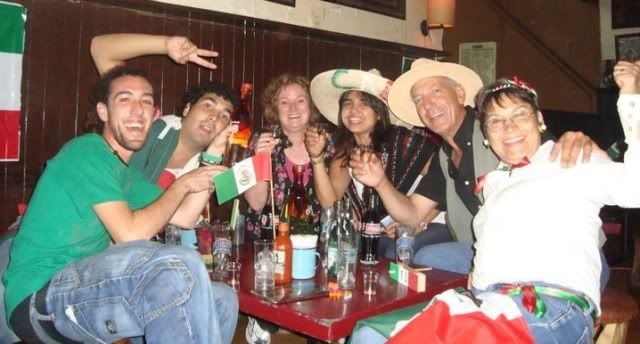
Three Mexicans, two Americans (one of whom is Chicano and fluent in Spanglish), and one Spaniard celebrating Mexico's bicentenario.
Not all unfortunately. Spanish isn't a prominent language here, I want to hear it though.
Being a newbie and one who can't say more than three words of Spanish in one sentence, I suspect that many new students of both languages will tend to mix in all they know of the "foreign" language and fill out the rest with their native language. I personally think that is a good way to get started, but hopefully that will only be a start and the speaker will eventually will use less of their native language and more of the ''foreign'' language. At least that's what I am going to do unless someone has a better idea. I wish I had to bucks to go to one of those immersion courses in some far away place, but don't look like that will be happening soon.
I did go to my first Skype chat on Feb 12 and I think that is the way to go. I think I might have got up to about five words of Spanish in one sentence and all but one were correct.
It's gong to be the 19th pretty soon so I had better bone up on my questions for my secret mystery month. Want a hint? Ha. Nope. Not gonna do it.
However.... I still believe there are certain times when Spanglish is very useful, and I think I am seeing a trend here. Could it be alcohol? Lol!
Happyquilter, the only times spanglish is useful - it dosen't even deserve English capitalization - is when a speaker is not proficient in Spanish, English, or both. And continuing to use spanglish just diminishes ones knowledge of the real languages even more.
Another thing to consider: As human beings, the first thing people consider when creating opinions about us is our appearence. The second is what comes out of our mouths. So you have to ask yourself: Do I want people to regard me as an enlightened person or a "homie?" I didn't make this rule of distinction; it's simply human nature.

















