Home
Q&A
La Palabra del Día : delante

La Palabra del Día : delante

12
votes

delante - (adverb) in front; opposite; ahead

Post your sentences in Spanish and English, then vote for the ones you like. The best answer will be chosen tomorrow on the basis of the greatest number of votes and language correctness.

.

And don't forget to correct your posts as suggested. Do NOT use subject pronouns!

Una vez, mi amiga abofeteó a su novio delante de todos

Once, my friend slapped her boyfriend in front of everyone.

alt text

10720 views
updated Dec 26, 2010
edited by Vaanz
posted by Vaanz
Please correct my English and Spanish - Vaanz, Dec 20, 2010
a su novio - 0074b507, Dec 20, 2010
Thank you Vaanz, great! - ray76, Dec 20, 2010

20 Answers

7
votes

Llegó con una mano delante y otra detrás.

He arrived penniless.

alt text

updated Dec 26, 2010
edited by Carlos-F
posted by Carlos-F
pennyless ;) ¡Qué palabra más bonita! - cogumela, Dec 20, 2010
Buen dicho! - JoyceM, Dec 20, 2010
penniless - Echoline, Dec 20, 2010
Thanks for your correction, Echoline. - Carlos-F, Dec 20, 2010
5
votes

Si ve vacas delante de Ud. en el camino, probablemente ha bebido demasiado.

If you see cows in front of you on the road, you've probably had too much to drink.

alt text

updated Dec 20, 2010
edited by Echoline
posted by Echoline
When you use a plural noun in a generic way, you don't use the article: 'Si ve vacas..'. Also, that 'de Ud.' sounds a bit awkward, the common expression there is 'suyo': 'delante suyo'. Finally, 'to have too much to drink' is simply 'beber demasiado' - bill1111, Dec 20, 2010
'Si ve vacas delante suyo en la carretera, probablemente ha bebido demasiado' - bill1111, Dec 20, 2010
"delante suyo" ?Are you sure, Bill? It sounds very odd to me... I'd say "si ve vacas delante de usted" - cogumela, Dec 20, 2010
4
votes

Cuando la vida te ofrezca muchos caminos delante de ti y no haya señales, búscala en tu corazón...

When life offers you many roads ahead of you and there are no signs, look for one in your heart...

alt text

updated Dec 21, 2010
edited by luz_72
posted by luz_72
Just as you used subjunctive for 'ofrecer', you need to put 'haber' in subjunctive as well: 'cuando te ofrezca.. y no haya señales. You could have said the same sentence in indicative mood, without changing the meaning: 'Cuando.. ofrece.. y no hay.. - bill1111, Dec 20, 2010
Also, 'to look for' is translated as 'buscar', without 'de'. And although 'busca una en tu corazón' is ok, it would be better to say: 'búscala en tu corazón' - bill1111, Dec 20, 2010
Beautiful thought! - JoyceM, Dec 20, 2010
Thanks Bill and Joyce:) - luz_72, Dec 20, 2010
Excellent metaphor! - Rolest, Dec 20, 2010
Thank you too, Rolest:) - luz_72, Dec 21, 2010
4
votes

¡No hay que contar el dinero delante de los pobres!
( Do not count the money in front of the poor! )

Proverbios argentinos

corrections will be accepted..! red face

alt text

updated Dec 20, 2010
edited by sv2qp
posted by sv2qp
'guita' means just 'money', not 'loot'. In fact this saying refers to counting ordinary money, in a casual way, in the presence of poor people. - bill1111, Dec 20, 2010
It is a proverb Bill. But I changed it anyway.. - sv2qp, Dec 20, 2010
Well, I didn't mean that you should change 'guita'.. I was just mentioning that 'guita' is a colloquial synonym of money in Argentina, so rather than 'loot' it was better to translate it as 'money'. - bill1111, Dec 20, 2010
4
votes

Cuando ves un coche de policía pegado detrás tuyo...desearías no estar delante!


When you see a police car close behind you… usually you wish you were not in front of it!

alt text

updated Dec 20, 2010
edited by Rolest
posted by Rolest
These conditional clauses are expressed in indicative, to denote that you are not wondering if it will happen, just describing a fact: 'If/when I see a cop.. I wish I hadn't'. If you were wondering what you would do if you see one, then you'd use subjunc. - bill1111, Dec 20, 2010
Wondering (yo): 'Cuando vea un coche de policía pegado detrás mío, probablemente desearé no estar delante'. Description (tú) (your sentence): 'Cuando ves un coche de policía pegado detrás tuyo, desearías no estar delante' - bill1111, Dec 20, 2010
I think it is"detras de mí" and"detrás de ti" - cogumela, Dec 20, 2010
Gracias Billstpor. This is a description of fact. I was a bit confused on how to write this. Thanks again for your help. - Rolest, Dec 20, 2010
4
votes

The car is in front of the house.

El carro está delante de la casa.

Funky car parked on Robson St Pictures, Images and Photos

updated Dec 20, 2010
edited by Brynleigh
posted by Brynleigh
I love art cars. - JoyceM, Dec 20, 2010
That car is in front of the house, but I'd say it's "over the top..." :-) - pesta, Dec 20, 2010
I love the Canadian license plate too! And that cute little curb-feeler. - pesta, Dec 20, 2010
lol, I really would like to do this on my brother's car but I cannot get him to agree to it! jaja - Brynleigh, Dec 20, 2010
4
votes

El banco está delante del hotel y del restaurante.

The bank is in front of the hotel and the restaurant.

updated Dec 20, 2010
edited by 0066c384
posted by 0066c384
'del hotel y del restaurante'. - bill1111, Dec 20, 2010
Thanks! - 0066c384, Dec 20, 2010
3
votes

Si te gusta este pastel de chocolate, de ahora en delante lo haré cada semana.

If you like this chocolate cake, from now on I'll make it every week. alt text

updated Dec 20, 2010
edited by Kiwi-Girl
posted by Kiwi-Girl
'de ahora en adelante' is the expression to translate 'from now on'. 'Delante' is used for locations (this is in front of that) - bill1111, Dec 20, 2010
This cake every week! -- that's what they call "Death by Chocolate" :-) - pesta, Dec 20, 2010
3
votes

Cada vez que está delante de mí estoy sin palabras

Every time she's in front of me I am speechless

updated Dec 20, 2010
posted by Dennis_the_Adventurer
A couple things. While 'de mí' is ok, it's much more common to use possesive pronouns after an adverb like 'delante', 'detrás', 'debajo' etc.. (eg: 'delante mío', 'detrás tuyo'). Also: 'to be speechless'= 'quedar(se) sin palabras' - bill1111, Dec 20, 2010
In this case: '.. delante mío, me quedo sin palabras'. If you simply want to say a plain 'I am speechless' though, you say 'Estoy sin palabras' or more commonly 'No tengo palabras'. - bill1111, Dec 20, 2010
3
votes

Un maratón de caminata comienza con un pie delante de otro.

A marathon walk starts with one foot in front of another.

Memorial Walk--the Marine Pictures, Images and Photos

updated Dec 20, 2010
edited by ray76
posted by ray76
'Both 'maratón' and 'caminata' are redundant. 'Caminata' already means a long walk. A normal, shorter walk would just be 'un paseo' or 'una vuelta'. - bill1111, Dec 20, 2010
2
votes

There was a car in front of me ,behind me and one on either side of me, I was hemmed in. había un coche delante de mío ,otro detrás y uno a cada lado , estaba encerrado.

updated Dec 21, 2010
edited by jennyo45
posted by jennyo45
The first part is ok. 'me estaba cercado' is incorrect grammar, though. 'Estaba cercado', without 'me'. Adding 'me' there would sound like: 'I was hemmed in to myself'. Another alternatives: 'Estaba encerrado' or 'Me habían encerrado' - bill1111, Dec 20, 2010
Just like I suggested in other sentences though, while 'delante de mí' is correct, it's much more common to say: 'Había un coche delante mío, otro detrás, y uno a cada lado' (you only need to say 'de mí' or 'mío' once by the way) - bill1111, Dec 20, 2010
Thanks again Billstpor..the more mistakes I make the more I learn ,,I do appreciate your patience. - jennyo45, Dec 21, 2010
2
votes

A veces, me parece que estoy delante de la computadora toda el día.

At times, it seems to me that I am in front of the computer all day. alt text

updated Dec 20, 2010
posted by DR1960
...todo el día. Good, DR! - cogumela, Dec 20, 2010
2
votes

The space shuttle Atlantis and the International Space Station passed in front of the sun last May 16 at 13:28 GMT. This photo was taken from Madrid, by photographer Thierry Legault.

El transbordador espacial Atlantis y la estación espacial internacional pasaron por delante del sol el pasado día 16 de mayo a las 13:28 GMT. Esta foto se tomó desde Madrid. Fue tomada por el fotógrafo Thierry Legault.

alt text

updated Dec 20, 2010
edited by pesta
posted by pesta
Wow!! I like the pic and the sentence. Just tiny mistakes, pesta "el transbordador" (masculine), "estación espacial"(tilde and no caps). Esta foto "fue tomada"... por "el fotógrafo". - cogumela, Dec 20, 2010
In case you want avoid passive here ( not necessary), it would be. El fotógrafo TL tomó esta foto desde Madrid. Another option: Esta foto se tomó desde madrid. Fue tomada por el fotógrafo TL - cogumela, Dec 20, 2010
2
votes

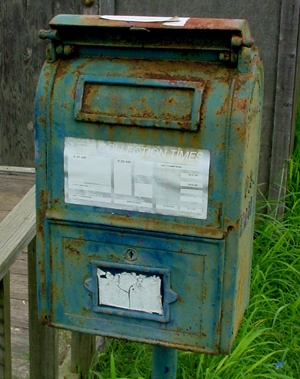
La caja del poste es delante del banco.

The postal box is in front of the bank.
alt text

updated Dec 20, 2010
posted by wansell
El buzón de correos está delante del banco. Hi, wansel! - cogumela, Dec 20, 2010
1
vote

alt text Hay un quiosko de periódicos delante del banco.

There is a newspaper stand in front of the bank.

updated Dec 21, 2010
edited by Maria-Russell
posted by Maria-Russell