Home
Q&A
La Palabra del Día : el choque

La Palabra del Día : el choque

10
votes

el choque - (noun) impact, crash, clash, collision; shock

Post your sentences in Spanish and English, then vote for the ones you like. The best answer will be chosen tomorrow on the basis of the greatest number of votes and language correctness.

.

And don't forget to correct your posts as suggested. Do NOT use subject pronouns!

La mayoría de los choques de coches ocurren debido al descuido de los conductores.

Most of the car crashes occur due to the carelessness of the drivers.

alt text

12916 views
updated Oct 27, 2010
edited by Vaanz
posted by Vaanz
Please correct my Englsih and Spanish - Vaanz, Oct 25, 2010
Usted ha hechoun gran eleccón Vaanz, bien hecho. - ray76, Oct 25, 2010
hecho un. - ray76, Oct 25, 2010
choques de coches, or choques automovilísticos - Tonyriva, Oct 25, 2010
Thank you guys.. :) - Vaanz, Oct 25, 2010

17 Answers

7
votes

El "shock" de un choque entre dos culturas puede ser devastador.

The shock of a clash between two cultures ,can be devastating .

Two cultures Pictures, Images and Photos

updated Oct 27, 2010
edited by ray76
posted by ray76
I'd say "El shock de un choque"... but I think that's only used in Mexico - Tonyriva, Oct 25, 2010
lol... Good picture.. :) - Vaanz, Oct 25, 2010
In Spain as well. 'Choque' is technically the correct translation of 'shock' when you talk about the medical condition, but in everyday speech -not even informally- people just say "shock". The comma is not needed, at least in Spanish - bill1111, Oct 25, 2010
Thank you so much guys , these are the kind of insider things that it is so important to get from the "cognoscenti" - ray76, Oct 25, 2010
One thing only.. when you use English words that are clearly not accepted as Spanish words -no matter how popular they are- it is customary to enclose them with " ", though I'm not sure if it is a hard rule. - bill1111, Oct 25, 2010
What's devastating Ray? Both women look gorgeous. Just a different dress sense, hehe. - Eddy, Oct 25, 2010
Thank you bilspor , you are my guardian angel. - ray76, Oct 25, 2010
It is devastating on my psyche Eddy , I can still dream you know! - ray76, Oct 25, 2010
5
votes

Fue un choque terrible para la madre enterarse de que su hija de 13 años había tratado de conducir el coche familiar y se había estrellado.


It was a terrible shock to the mother, to learn that her 13 year old daughter tried to drive the family car and crashed it.

alt text

updated Oct 26, 2010
edited by Rolest
posted by Rolest
Su madre "tuvo un shock" cuando.... " "de la familia y se estrelló", also "tuvo un accidente" . - cogumela, Oct 25, 2010
"de que su hija". "Crashed it" can be translated as "se estrelló" or "lo destrozó" if you want to underline the fact that she wrecked it, rather than "had an accident". - bill1111, Oct 25, 2010
I am changing the whole sentence! Very frustrated!!! I hope this new sentence works!!! - Rolest, Oct 25, 2010
However thanks for all your help. I am not angry at anyone. I am just very frustrated. - Rolest, Oct 25, 2010
(oops) Well.. The way I'd say it would be: "Fue un "shock" terrible (or "tremendo") para la madre enterarse de que su hija de 13 años ("de edad" is redundant) había tratado de conducir el coche familiar y se había estrellado" - bill1111, Oct 25, 2010
It's good grammar practice, isn't it? :) - bill1111, Oct 25, 2010
Okay, got it this time...I hope! However, I have to leave in choque for shock, it is the word of the day. My Oxford Spanish Dict. defines one of the meanings of this word to be "shocked" as in surprised. - Rolest, Oct 25, 2010
Yes, it is absolutely correct, you can leave it there if you prefer. Just keep in mind that "choque" isn't too common in this context. - bill1111, Oct 25, 2010
Thanks for all your help Billistpor, I really appreciate it! - Rolest, Oct 25, 2010
4
votes

Casi tuve un choque frontal con un árbol porque estaba mirando a las bellas mujeres que estaban corriendo alrededor el parque cerca de mi casa. I almost had a head on collision with a tree because i was looking at the beautiful girls that were running around the park by my house.

updated Oct 26, 2010
posted by pescador1
You need a comma after 'árbol'. Also, ".. alrededor *del* parque", and you need to link 'cerca de mi casa' to 'parque' with a subordinate clause 'el parque que está cerca de mi casa'. - bill1111, Oct 25, 2010
3
votes

El pájarito se asustó cuando el cable le dio un choque eléctrico.

The wee bird got a fright when the cable gave him an electric shock.

alt text

updated Oct 25, 2010
posted by amy_moreno
Hi, amy! Pajarito, without tilde. Stress in "ri" - cogumela, Oct 25, 2010
Also, and please don't take me wrong (haha), "pajarito" is slang for manhood among little children, so I couldn't help but giggle when I read "el pajarito se asustó" - bill1111, Oct 25, 2010
.. and "choque eléctrico", while correct, is not used very often. It sounds too technical. More popular ways are "dar/recibir una descarga/calambre/calambrazo " or "electrocutar(se)" - bill1111, Oct 25, 2010
hehehehe! - cogumela, Oct 25, 2010
Funny, Bill! - --Mariana--, Oct 25, 2010
2
votes

The collision was loud and now I need a new car..

El choque fue fuerte así que ahora necesito un coche nuevo.
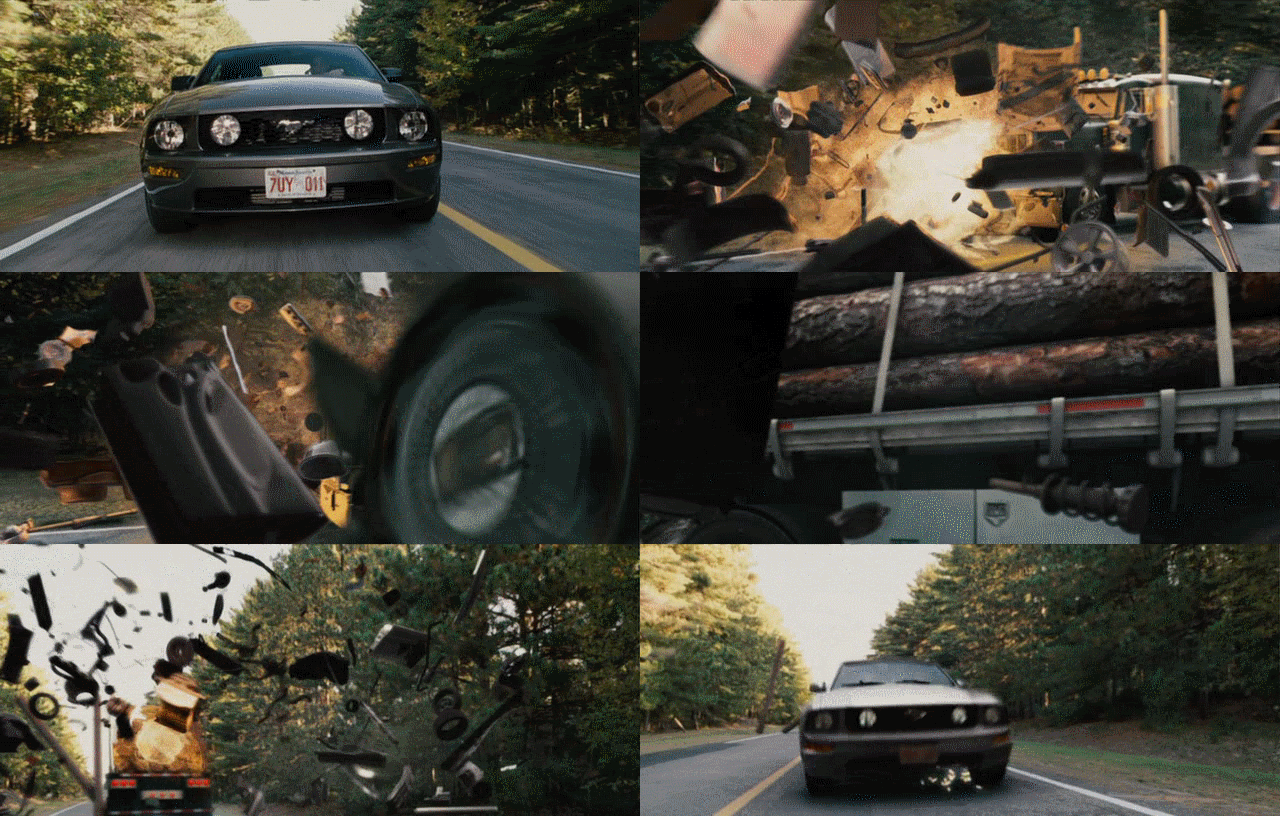
car crash Pictures, Images and Photos

updated Oct 26, 2010
edited by Brynleigh
posted by Brynleigh
It's grammatically correct, but at least in Spanish it is expected to use a conjunction that suggests causality in a sentence like that: ".. fue fuerte, así que ahora necesito un coche nuevo" - bill1111, Oct 25, 2010
A panel beaters nightmare. - ray76, Oct 25, 2010
Wow, great photo! - --Mariana--, Oct 25, 2010
"así que" doesn't need the "y" in front, it replaces it as a conjunction. It's like saying "The collision was loud, *so* now I need a new car", where 'así que' would be the translation of 'so'. - bill1111, Oct 25, 2010
Gracias, Billstpor:) - Brynleigh, Oct 25, 2010
2
votes

Cuando vivíamos en Caracas podíamos ver la autopista desde nuestra casa. Por la noche nos sentábamos en el balcón y mirábamos los choques por entretenimiento. Los caraqueños no sabían conducir muy bien.

When we lived in Caracas we could see the freeway from our house. At night we sat on the balcony and watched the crashes for entertainment. The people from Caracas couldn't drive very well.

alt text

updated Oct 25, 2010
edited by KevinB
posted by KevinB
That is dreadfull, they are all 60s cars. - ray76, Oct 25, 2010
A shame, I know. When I was there a lot of them were 60's cars. The newest ones were 70's cars. I'm dating myself. - KevinB, Oct 25, 2010
I'd say "nos sentábamos" and "por entretenimiento" - Tonyriva, Oct 25, 2010
"desde nuestra casa". And yes, either "por entretenimiento", "por diversión" or "para entretenernos". Also, "no sabían conducir" - bill1111, Oct 25, 2010
Heven't you noticed the woman driver slinking away without being noticed. - Eddy, Oct 25, 2010
I did Eddy, and thought the sneaky old darling will get away with it. - ray76, Oct 25, 2010
Thanks. - KevinB, Oct 25, 2010
2
votes

Las ondas de choque se puede ver detrás de este avión viaja más rápido que el sonido.

Shock waves can be seen behind this jet traveling faster than sound.

alt text

updated Oct 25, 2010
posted by pesta
My version: "Detrás de este avión que viaja más rápido que el sonido pueden verse las ondas de choque". I guess those "que.. que.." sound a bit strange, but they are needed. - bill1111, Oct 25, 2010
1
vote

Hace tres años que perdimos al mejor cantante del país y la región en un choque entre un coche y un camión. Se llamaba Tose Proeski y sólo tenía 26 años. ¡Que descanse en paz!

Three years ago we lost the best singer of the country and the region in a car crash. His name was Tose Proeski and he was only 26. May he rest in peace!

alt text

updated Oct 27, 2010
edited by luz_72
posted by luz_72
Actually in Spanish we don't use in this context "choque de coche", but "un accidente de coche". - cogumela, Oct 25, 2010
Even so, your sentence is perfectly understable. - cogumela, Oct 25, 2010
I read this often in Prensa.com: "Choque causa tranque hacia Panamá Oeste" May be common usage in Panama? - pesta, Oct 25, 2010
Yes, "car crash" or "plane crash" is usually translated as "accidente (de coche) (aéreo)". On the other side, "train crash" can be translated as "choque de trenes" if it involves two trains (besides "accidente.. ") - bill1111, Oct 25, 2010
If you don't use "de coches" then it is a valid alternative. Also if you want to describe a crash between a car and something else: "un choque entre un coche y un camión.." - bill1111, Oct 25, 2010
Exactamente lo que pasó, Bill...thank you all for the explanation... - luz_72, Oct 27, 2010
1
vote

He estado viendo un supuesto choque entre dos ovnis en Colombia..

I have been watching a supposed crash between two UFOs in Colombia.

misterio por ovnis

updated Oct 26, 2010
edited by galsally
posted by galsally
"Colombia" is spelled with two O's in both languages - bill1111, Oct 25, 2010
Thanks Bill, all these years I've been confusing the spelling with that of Columbia, Maryland then! Oh dear. :/ - galsally, Oct 26, 2010
1
vote

Un choque entre los atletas es a veces muy dolorosas.

A collision between athletes is sometimes very painful.

alt text

updated Oct 25, 2010
posted by bandit51jd
1
vote

Paso miedo cuando veo un choque en la carretera.

I am frightened when I see a crash on the highway.

alt text

updated Oct 25, 2010
edited by revmaf
posted by revmaf
That sentence would be perfectly understood. Still, when you want to to say "I am frightened/scared" for a period of time, rather than in a particular moment, you use the expression "pasar miedo" instead of "tener miedo". - bill1111, Oct 25, 2010
In this example I'd say: "Paso miedo cuando veo un choque en la carretera". However if you were driving past a car crash and someone would ask you how you feel, you would say "Tengo miedo" - bill1111, Oct 25, 2010
Thank you, very clear explanation. I think I meant to describe period of time rather than particular moment so I'm changing it as you suggested. Many thanks! - revmaf, Oct 25, 2010
1
vote

Conducir borracho es la causa de 40% de choques fatales de coche en EEUU.

Drunk driving is the cause of 40% of fatal car crashes in the U.S.

alt text

updated Oct 25, 2010
posted by wansell
"la causa del 40% de los choques mortales con el coche en EEUU". In Spain we use a slightly different expression: ".. de los accidentes mortales en carretera en EEUU" - bill1111, Oct 25, 2010
1
vote

Todos los viernes hay un choque en el puente, mi camino a casa sólo. O una elevación del puente. ¡Aún mejor!

Every Friday there is a crash on the bridge, my only way home. Or a bridge lift. Even better!

updated Oct 25, 2010
posted by 008f2974
"el único camino a (mi) casa" or "el único camino para llegar a (mi) casa". Also, "Una elevación del puente" is correct as a translation of "Or a bridge lift", but is not idiomatic. "O suben el puente" sounds better: "Or they lift the bridge" - bill1111, Oct 25, 2010
1
vote

Hubo un choque esta mañana, entre efectivos militares y sicarios narco traficantes en ciudad juarez, mexico.

There was a clash this morning, between military personnel and drug trafficking assassins. in ciudad juarez, mexico

alt text

updated Oct 25, 2010
posted by 002262dd
Those assassins only work for the drug cartels, they are not traffickers themselves. I'd call them "sicarios de los narcos/narcotraficantes" and in English maybe drug cartel assassins. - bill1111, Oct 25, 2010
1
vote

Me choca ver todas las imágenes maravillosas en este hilo.

I'm shocked to see all the wonderful pictures in this thread. alt text

updated Oct 25, 2010
posted by pesta
Hm, despite the similarity between "chocar" and "to shock", it doesn't fit here. "Chocar" has a narrower scope of uses than "to shock". Basically it means "I get a weird or bad feeling from this" - bill1111, Oct 25, 2010
I'd translate it as "Me quedo sorprendido de (or "al") ver todas las imágenes.." - bill1111, Oct 25, 2010
Thanks, Billstpor, for the helpful advice. - pesta, Oct 25, 2010
















