
Frustrating goofiness... I already had some cake.
I've pretty much gotten beyond the embarrassment of using the wrong words, the wrong 'mood', the wrong tense, I'll usually just throw something out and see if it sticks. I ran into a situation yesterday that was a bit different for me, I just didn't know what to 'throw out there' so I had to make something up.
I was asked if I wanted some cake, and what I wanted to say was 'I already had some cake'. To my amazement and surprise, my mind goes blank and I just don't know how to say 'I already had some cake'. So, I tried to put a literal translation together, and from the moment I said it I knew it wasn't right but it was all I had.
I said something like 'ya tuve alguno pastel', and from the expressions on the three faces in front of me, I knew they didn't have a clue what I was trying to say. In my English mind it made perfect sense, 'I already had some cake'. They started discussing amongst themselves what I was trying to say, and they would ask me questions like ¿Tuve? ¿En el pasado? The expressions didn't change, I wasn't making any progroess. We went nowhere in a hurry.
Fortunately, a friend overheard my struggle, and since he is fluent in Spanish and English I welcomed his help. He said something like 'comí alguno pastel', and then told me "You're trying to say you ate some cake, not that you had some cake". To the contrary, I said. I had some cake, what's so hard to understand about that? He finally convinced me that "I ate some cake" was the right thing to say, but I was amazed at how the words 'ya tuve alguno pastel' made absolutely no sense.
I guess I was shocked at the complete disconnect in my mind, and also in the minds of the three people that heard me. I just ain't there yet.
14 Answers
I don't know, Jack... The whole situation sounds a bit odd to me, like it's just a bit too inflexible.
I don't know where you are, and much less the background of the people you are seeing. That could make a big difference.
If you had said to me, or any of the people I know: "ya tuve alguno pastel", I would had pinned you down immediately as a gringo (no offense meant at all) who is struggling with Spanish - sure - but I would have understood what you meant.
I really do not understand the whole argument between "tuve pastel" and "comí pastel". I mean - yes, it really is not correct to say "tuve pastel", because that means that it was in your possession, not that you ate it, but so what? You just offered the guy some cake, and he said no because he has recently been in possession of some. He probably means he ate some already.
Whatever. Let's say that you are in a place where people don't have a lot of experience with foreigners, and don't really have a lot room for flexibility in their understanding of the language. I think there is one important cultural lesson here for you nevertheless. Please don't think I'm being harsh. I think awareness of this fact will help you a great deal in the future:
In many Latin American cultures, and particularly among the less well-to-do folk, it is considered extremely rude to decline an offer to a tidbit to eat and / or a coffee. People may be trying to welcome you into their homes, and hospitality rules demand that they offer you something. It would be rude of them not to. Likewise, it would be considered rude of you not to accept.
Anyway, it is my estimation that the root of your problem was not so much your inability to make yourself understood, but the inability of your hosts to find a graceful way to deal with your social faux-pas.
My wife is from an Andean country, where this is a sacred custom even in the higher strata of society. She's long shed that custom, but her family has not. So I've been dreading the day when we eventually go visit them, because I know that if we make more than one visit in a day (and we will have to because "manners" require it) we will get stuffed like pigs.
I would like to advise you not too feel too bad about it either way. People will understand that you haven't mastered the language yet, and that you are probably not familiar with their customs. Next time be prepared, and be ready to accept whatever you are offered. If you make a mistake in what you're trying to say, don't be too proud, nor too hard with yourself. If you just smile sheepishly and say "Lo siento, a veces no me sale lo que quiero decir", people will probably laugh and try to help you out. Relax, go with the flow, and be willing to learn, whichever way the learning comes to you!
Hey, Jack..you always put a smile on my face!
In English we use the word "have" as a way to say "eat" or "drink" - such as, "I'll have the cake", or "what did you have to drink?"
In Spanish. "tener" doesn't have that meaning; that's probably why the 3 faces were blank! "Ya tuve algo de pastel" would mean more "I already got (I had in my hand, I held in my hand) some cake."
On the other hand, hey...if they gave you another piece, you could have had your cake and eaten it, too! 
Heidita said:
I am sorry, maybe it is the teacher speaking, but we cannot always find the mistake and the error in the inflexibility of the natives if we are not understood. I do not agree with Gekko, that sentence was completely unclear and I am not surprised at their reaction.
And that was the big surprise to me, the complete disconnect. These three folks only speak a tiny bit of English, so they had no 'English reference' to fall back on.
I do understand that you can't use tener for food, just as I know to use an umbrella to keep from getting wet in the rain. The problem is, I forgot both 
Thank you so much for the insight!
I am sorry, maybe it is the teacher speaking, but we cannot always find the mistake and the error in the inflexibility of the natives if we are not understood. I do not agree with Gekko, that sentence was completely unclear and I am not surprised at their reaction.
I would personally have understood you, and that is the English part of Gekko. We speak perfect English, so we immediately react and say, oh, he had some cake, great, he is saying he ate some cake! .... By the way, this is pastel in Spain.
From the teaching perspective, Heidita is, of course, absolutely right. If we say something that is not correct, we cannot expect people to understand us. However, we have an interesting, real-life situation here, and I wanted to focus on that.
There are a lot of elements at play: the level of English of our "victims"  , how much experience they have with foreigners, our level of Spanish, how far off we are from what we intend to say, how creative we are the moment of trying to convey some information, and so forth.
I have been in places where the people also speak very little-to-none English, but they have plenty of experience with clueless tourists who also speak very little Spanish. It is amazing how much information can effectively be exchanged under those conditions, by virtue of made-up words, mime, and force of will alone. Specially if the natives are intent on selling something to the tourists!
In the case described by Jack, the environment was rigid. By that I don't mean to say that the Spanish speakers were not willing to make an effort. At a given point, everyone just ran out of tools to exchange information.
As shown by Heidita's excellent thread on María José Navarro's column, there are situations where even two native speakers of the same language cannot easily communicate. I had not frame of reference for the colloquialisms being used by María José, and so it is even possible that I may have understood her better if she had written in English!
Had I been speaking with her directly, however, I would have had to ask her to explain what the different terms meant. Her command of the language is such that she could have run circles around me, poking fun without me even noticing!
So what's a language learner to do, when thrown in a situation like Jack's?
Of course, refusing to interact with people in "real life" situations until "my language level" is high enough, is not an option. That's one way to ensure that our level will never get past a certain point.
I think the only practical alternative is to take our chances, go for it, be flexible, and be willing to eat some humble pie (¿"pastel de humildad, torta humilde"?? heh-heh ) from time to time. The Alvite thread that Heidita posted today is perfect for a reflection about this particular issue.
Go out on a limb- try different things, be willing to laugh at yourself, use mime, and have a few "please -forgive -my- ignorance" phrases ready as backup: "Lo siento, mi español no es muy bueno, ja, ja!", "disculpe, ¿dije algo equivocado? A veces me confundo", and so forth.
And observe what people are doing! If you are given something to eat, is everyone sitting up with some food in their dish, watching you eagerly and waiting for you to eat? Then eat. Is everyone being served something, and everyone is eating every last bit on their plate? Then make sure you eat everything.
Is everyone eating just a spoonful or two, and leaving some food on the plate? Then that's the polite thing to do: have a little, compliment the hostess, push the food around a bit, and after a while you can leave the rest as you go talk to someone else.
There are some strategies for dealing with food-intensive social occasions. Do not refuse, but ask for just a little, for example: "¡Gracias - sólo un poquito para probar. ¡Estoy a dieta!, ja, ja!", or "¡Oh si, muchas gracias, pero solo un poquitito - he comido mucho!" Again, watch the people, see how they act, listen to what they say!
Anyway, sorry for carrying on. Sometimes it is more about what you do - or don't - than about what you say!
Oh, and by the way, I am not used to the word "pastel", either. For me, "cake" is "torta", and "pastel" is "pie". In Puerto Rico, "cake" is "bizcocho", and sometimes "pastel", although "pastel" traditionally refers to something entirely different!
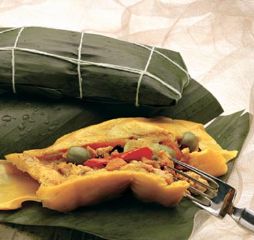
This is a "torta" in Venezuela:
Gekkosan wrote:
Anyway, it is my estimation that the root of your problem was not so much your inability to make yourself understood, but the inability of your hosts to find a graceful way to deal with your social faux-pas.
I think you have hit on something big here. I had just left the supper table and was stuffed silly. I had refused every offer of food but finally gave in with the cake. Me thinks I have committed a big one..
Your points are well taken, thanks so much! I really appreciate the insight.
I would have eaten more cake. It's easier than trying to find the right response, more polite than refusing, and you get to eat more cake. Everybody wins !
Great story, Jack. It's great that we can make mistakes and laugh later.
"Va a disfrutarme" (you are going to enjoy me) instead of what I intended, which was "Va a disfrutarlo" (you are going to enjoy it).
Why wouldn't it be "Ya comí algo de pastel" instead of alguno pastel? That's how I would say it. Gracias.
We wouldn't even say pastel :p
jeje
Tener is definitely not used for food, Jack, lesson 1.3, 1.4
I also created a Pepa thread on this topic and there is no way you can use tener for food.
Tener in Spanish indicates possession. Not to eat. While if you use instead of had to eat in English (I ate lunch instead of I had lunch), it would be perfectly well said. however, Tuve una mazana and Comí una manzana are like day and night.
Tuve una manzana. I had an apple (in my possession at one moment in my life)
Comi una manzana. I ate an apple.
Tuve una pastel . I had a little cake (when I was a child once in my life)
Comí algo de tarta. I ate a some cake.
I am sorry, maybe it is the teacher speaking, but we cannot always find the mistake and the error in the inflexibility of the natives if we are not understood. I do not agree with Gekko, that sentence was completely unclear and I am not surprised at their reaction.
I would personally have understood you, and that is the English part of Gekko talking We speak perfect English, so we immediately react and say, oh, he had some cake, great, he is saying he ate some cake!
But I gather those who were with you did not speak English, sorry, this cannot be understood.
By the way, this is pastel in Spain.

Not to make too much of this, it's kind of interesting to me that I've been advised to eat cake or whatever is offered to me, whether or not I'm about to throw up from eating, plus other 'social skills'. Sheesh, are you ever allowed to say 'no' to food in Latin America? I guess not
Everything seems to be alright, nobody acts like they are angry with me, we had a big Día de las Madres gathering today after church and we all had a good time.
I guess the main point I was trying to express was, I was amazed at the complete disconnect when I said the wrong thing trying to get a point across. Since my friends had no English point of reference to "cross reference" English to Spanish or vice versa, then came the disconnect. Language is just a series of sounds and our brain has the wonderful task of parsing the data coming through our ears into meaningful words. Our brain (mine, at least) can't properly parse these sounds when there is no accompanying word in the databank. I can imagine the same no matter what language is being spoken.
For what it's worth, I speak perfect Spanish at home, not at all perfect when I'm actually talking to my Latino friends 
By the way...had is tuve past tense of have (tener), this is an irregular verb have - had - had (presente - pasado y futuro)
In spanish like english verbs are verbs you can´t say had food yu say ate food, ate cake, ate meat and so on...
he turned to me and said ¡Margaret! ¡Cómete! I think I was more embarassed than he was.
great margeret, I am still laughing.
Your title says it all - and we've all been there, I was with a group of friends in a restaurant and one kind fellow who was not a native Spanish speaker was 'being host' and trying to get everyone to finish up the last of the chicken - he turned to me and said ¡Margaret! ¡Cómete! I think I was more embarassed than he was.
When someone tries telling me a few words in French I try my best efforts at making sense of what they say as it is pleasing they even tried and I want to praise them for it.
I am a bit frustrated that a lot of things I learn here and try out on my friend from Peru end up in his response..."qué bien, but that's not how we would say it", even simple words like cerdo...so I'm not sure anymore who is right and who is not

















