
I would like to better understand the noun "libraco"
In a passage from La isla bajo el mar, a notary enters a home with his clerk and
"un libraco de tapas azules".
Now I have read about how one forms new words that one might not find in the RAE, for example, by appending suffixes. I have also read that some are diminutives (-ito), some augmentives (-ón), and I thought that -aca belonged to the category one calls pejoratives.
Yet my Gran Diccionario Oxford provides a translation of "big whopping book" for "libraco".
I would be keen to know more about these endings. Does one just have to learn the accepted formations, or could our joven escribiente have been carrying a librito, a librón or librazo?
What image does "libraco" conjure up in the mind of the native speaker? And - oh yes -, I find it curious that a book comes with "tapas azules"? In fact, I'm not sure at all what such a big whopping book must look like.
I guess I at least understand why "el notario" will most likely have had his "joven escribiente" carrying it.
15 Answers
This is terrific! I can piece together what both of you have shared, h1deaway and Gocika, to conclude that this big book really is an "-aca" (pejorative) .
It is probably so old and has most likely recorded so many notary transactions in the hot and humid climate of Haiti, to boot. The story takes place in the 17th and 18th centuries (time frame of La isla bajo el mar, if I am not mistaken)!
I can see now that it is not that notaries and their joven escribiente necessarily carry around something called a "libracos"...Indeed, this particular example was probably once just a "libro grande" - importante, también - before so many transactions were recorded that it is now showing the signs of wear. And -aca or not, it is still importante!
My daughter lives in Bogotá, h1deaway, and I think that when I get a chance to visit her, I am going to ask to visit a notary's office
Thank you both!
I would be interested in knowing which dictionary you have that includes a section on suffixes.
The University of Chicago Spanish-English Dictionary, Fifth Edition, which, by the way, I happened to buy at Wal-Mart for like 3.99 or thereabouts.
The section on suffixes is on pages 8 and 9, but Amazon's Look-Inside feature (if you select First Pages) stops at page 7. ¡Qué suerte!
FYI - I don't know about other Spanish-speaking countries, but here in Colombia, you must be an attorney to be a notarty. The notaries here perform marriages as well as record the deeds. They also record land transfers, everything. In the small town I live in, nothing is automated. They have old Selectric typewriters that they use. The walls are lined with books like the one that word refers to (I think).
Look what I found online! The pages on suffixes from the dictionary mentioned by webdunce
Janice asked:
What image does "libraco" conjure up in the mind of the native speaker?
Although the RAE says
"libraco": libro despreciable
Actually... I don't understand what a "libro despreciable" is... 
.
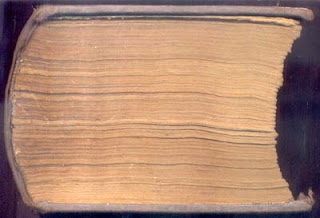
This is what I see in my mind when I say "libraco" or "libracho"
You asked h1deaway, if I have read many books in Spanish.
No, this is my first. As I often mention in one or another post, I am stubbornly trying to learn "by ear" and listening to audio books on CD, some of which are recorded with a technology that allows one to read along and even slow the speech down. These examples I have all include an "audio" only CD, as well, and I only take advantage of the main CD-ROM "written" material or the enclosed little paper booklet when I have come to my wits end trying to hear what the reader is actually saying.
I use Audacity audio editing software to slow some of the speech down on my own. Unfortunately, slowing the reader down is not always "the ticket" and sometimes I just have to give up.
A big shortcoming of Span¡shD!ct.com is the missing function to upload and post/share 30-second bits of sound to accompany questions. The site used to include such a possiblity, much like the one to upload pictures.
By the way, my first CD audio book was also a children's story: Historia de una gaviota y del gato que le enseño a volar ISBN 978-3-89747-782-7 Podría sugerirte ese libro/CD da Digital Publishing. La grabación incluye la posibilidad de hacer más lento la lectura :--) ....Es de "Nivel 1". El escritor es Luis Sepúlveda, chileno. La dedica a sus niños.
La historia interminable is Michael Ende's Die unendliche Geschichte (English: The Neverending Story), right?. I have not read it but did read his Momo to my daughter when she was a child.
I will ask my daughter now if she has ever been to El Peñal!
Now that I realize it is libro + aco, I want to add that my dictionary, in its section on suffixes, actually provides libraco as an example and says it means "large, bulky book." Somewhere else (other than in this thread), and I can't remember where, I saw it translated as "tome" (which is the English word for large, bulky book).
Interestingly: librazo
Interesting, yes, yes! But looking for others I found cabezazo - useful to footbal sportscasters! and I guess that the head doesn't quite fit the characterization of "inanimate object". So maybe we can change your explanation to a yet more general "...adding -azo to the end of the word for something = a blow with that something."
I must admit that I share your expression of resignation: "..Or something like that." Anyway, with regard to my question expressing a desire to better understand this word, I can now be sure that Isabelle Allende would not have employed "librazo":--) Libraco it had to be!
I saw it translated as "tome" (which is the English word for large, bulky book).
You saw it here, webdunce, provided by gocika from an entry in a Collins online dictionary.
By the way, which dictionary do you use that has a section on suffixes?
Also, apparently -ón turns the noun it is added to into an adjective (as well as indicating augmentation).
Aha!!.....I am so happy to learn these (augmenting:=) details, webdunce.
I hesitated before posting, because I had already figured out that our "joven escribiente" was carting a big book around. As I mentioned, my Gran Diccionario Oxford had provided me with both (fam) (libro grande) "big whopping book" and (libro malo) "lousy book" also (colloq).
((Fam) and (colloq) are dictionary abbreviations for familiar and colloquial)
I really appreciate seeing something codified that it would take me ever so long to distill from hearing native speakers speaking in their native environment.
Speaking of my Gran Diccionario Oxford, it's not so gran anymore. Reading La isla bajo el mar entails looking up so many words for me - always Spanish to English -- and the dictionary (tapas negras) is so heavy,... that I cut it down its spine in two.
Of course now it looks a bit like a "libraco".
Also, apparently -ón turns the noun it is added to into an adjective (as well as indicating augmentation). Ejemplo: cabezón = large-headed.
So, I guess librón = big-booked (which is meaningless to me).
Interestingly: librazo
I get the impression that adding -azo to the end of words referring to living things = augmentation, but that adding -azo to the end of inanimate objects = blow with said object. Or something like that.
You are very welcome. I am glad I could help. Have you read many books in Spanish? I am readnig my first. A friend lent me La Historia Interminable - yes, the childrens book. I thought it might be a fairly easy read. Wrong! Although, my recognition speed of moods and tenses has doubled and so has my vocabulary. Hurray!
Have you been to Colombia before? It is an absolutely beautiful country! I live in Antioquia, near Medellín in the very small town of El Peñol. I have not yet been to Bogota, but I am looking forward to visiting there soon.
For what it's worth, I am imagining one of the enormous handwritten tomes you would see in a notary office.

















